Canto
10
Canto
10
Chapter 49: Akrûra's Mission in Hastinâpura
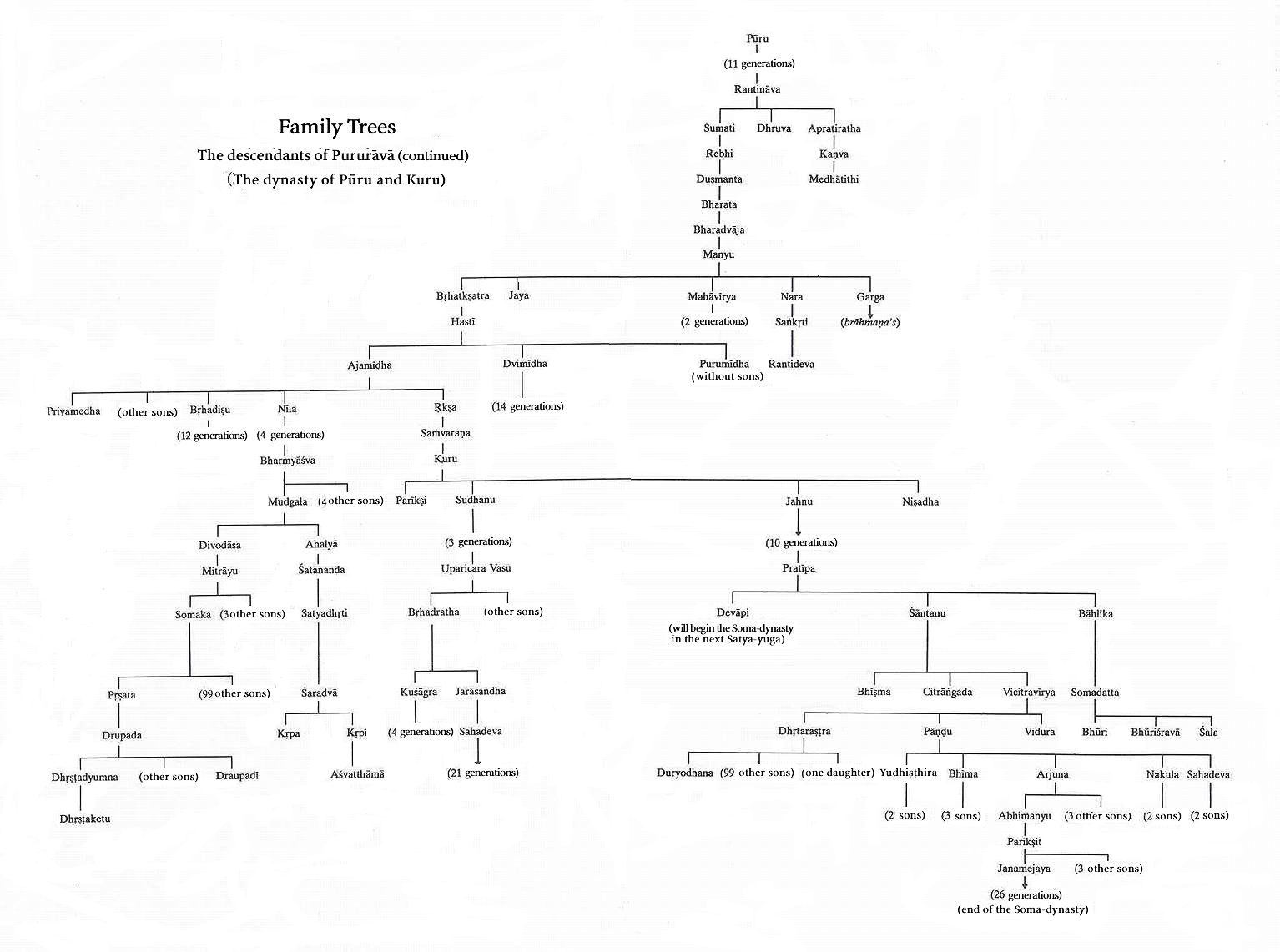
(1-2) S'rî S'uka said: 'He [Akrûra] went to Hastinâpura, the city marked by the glory of the kings of the Pûru dynasty [see family-tree], and saw there the son of Ambikâ [Dhritarâshthra, see 9.22: 25] together with Bhîshma, Vidura and Prithâ [Kuntî], as also Bâhlika and his son [Somadatta], Dronâcârya and Kripâcârya, Karna, Duryodhana, the son of Drona [As'vatthâmâ], the Pândavas and other friends. (3) After the son of Gândinî [Akrûra, see 9.24: 15] appropriately had greeted his relatives and friends, they inquired with him for news about their kin, whereupon he in turn asked how they were faring. (4) He stayed there for a couple of months in order to find out what the king, who could not raise his voice against his wicked sons, was doing in following the advise of mischievous persons [like Karna]. (5-6) Both Vidura and Kuntî told him everything about the unbecoming acts - like the administering of poison - that the sons of Dhritarâshthra had perpetrated in their intolerance for the influence, skill, strength, bravery, humility and so on of the sons of Prithâ, whose excellent qualities were loved by the citizens. (7) Now that Prithâ saw her [Vrishni-]brother Akrûra before her, she, remembering her place of birth [Mathurâ], addressed him and said with tears in her eyes: (8) 'Oh gentle soul, do our parents and brothers, my sisters, nephews and the women of the family, as also my [old girlhood] friends, still remember us? (9) Do the son of my brother, Krishna, the Supreme Lord, the shelter full of care for the devotees, and Balarâma with His lotus petal eyes, still think of the sons of His father's sister? (10) And... will He come to console me with His words, I who with young boys deprived of their father in the midst of enemies am lamenting like a doe between the wolves? (11) Krishna, oh Krishna, oh Greatest Yogi, oh Soul and Protector of the Universe, please watch over this surrendered soul who together with her children is drowning in distress, oh Govinda [see also 1.8: 17-43]! (12) For mankind in fear of death and rebirth, I see no other shelter than Your lotus feet, oh Master and Controller granting liberation. (13) My obeisances unto You, Krishna, the pure Absolute Truth and Supersoul, the Lord of Yoga and Unifier of Consciousness; You I approach for shelter.'
(14) S'rî S'uka said: 'Oh King, Your own great-grandmother, thus remembering her relatives and Krishna, the Controller of the Universe, began to cry loudly over her misfortune. (15) Akrûra, equanimous in distress and happiness, and the illustrious Vidura, consoled Kuntî by reminding her of those [the gods] who fathered her sons [see family-tree]. (16) When it was about time to leave, he approached the king amidst his supporters, who was fully determined by his sons [and his foster sons] whom he treated unequally. He wanted to relate to him what in friendship was communicated by his well-wishing relatives [Krishna and Râma]. (17) Akrûra said: 'Oh dear, beloved son of Vicitravîrya [9.22: 21-25], to the greater glory of the Kurus you, after the demise of your brother Pându, have now assumed the throne. (18) Dutifully protecting the earth and the citizens, delighting the people with your good character and treating your relatives equally, you will achieve perfection and renown! (19) Acting to the contrary however, you will be condemned in this world and land in darkness. Therefore always be equal toward the Pândavas and your own sons. (20) No one in this world, oh King, is given a continuous association with whomever. Not even with one's own body the association continues. So what to say about a wife, children and so on? (21) A living being is born alone and dies alone. Alone one enjoys the good consequences [of one's actions] and alone one has to face the bad consequences. (22) The wealth that was acquired by an unintelligent person lacking in dharma, is seized by others in the guise of dependents [like relatives], just like the water of a fish [will be occupied by its own offspring]. (23) Those who, lacking in wisdom, maintain their life, wealth and children in disrespect of dharmic matters and think 'I am the owner', end up destitute and abandoned, being frustrated in their purposes [see 4.31 6.15: 21-23 and 7.15]. (24) Blind to his own dharmic duties being abandoned by them, he, not conversant with the purpose of life and with his goals unfulfilled, has to carry his load [all alone] and will enter the deepest darkness [see also 3.30; 5: 26; 6.1: 40]. (25) Therefore, seeing this world as a dream, oh King, as something magical, as a thing of the mind, bring that mind under control with intelligence and thus find your balance and peace, prabhu.'
(26) Dhritarâshthra said: 'I can never get enough of the auspicious words you speak, oh master of charity, they are, for a mortal like me, as the nectar of immortality! (27) But however pleasing they might be, oh gentle one, they are, just like lightening in a cloud, not fixed in my wavering heart, because I am partial in my attachment to my sons. (28) What person can defy what is ordained by the Lord who descended in the Yadu family in order to diminish the burden of the earth [see B.G. 9: 8]? (29) He whose path is inconceivable, creates this universe by His own creative energy, distributes the modes and enters them. My obeisances unto Him whose actions are inscrutable, the Supreme Lord with whom we find liberation from the cycle of birth and death.'
(30) S'rî S'uka said: 'The descendant of Yadu [Akrûra] thus being apprised of the mentality of the king, took leave of his well-wishers and returned to the capital of the Yadus. (31) According to the purpose for which he was sent, oh descendant of Kuru, he reported to Râma and Krishna how Dhritarâshthra was behaving toward the Pândavas.'


Third revised edition, loaded March 25, 2021.
Previous Aadhar edition and Vedabase links:
S'rî S'uka said: 'He [Akrûra] went to Hastinâpura, the city marked by the glory of the kings of the Pûru dynasty [see family-tree], and saw there the son of Ambikâ [Dhritarâshthra, see 9.22: 25] together with Bhîshma, Vidura and Prithâ [Kuntî], as also Bâhlika and his son [Somadatta], Dronâcârya and Kripâcârya, Karna, Duryodhana, the son of Drona [As'vatthâmâ], the Pândavas and other friends.S'rî S'uka said: 'He [Akrûra] going to Hastinâpura, the city standing out with the glory of the kings of the Pûru-dynasty [see family-tree], saw there the son of Ambikâ [Dhritarâshthra, see 9.22: 25] together with Bhîshma, Vidura and Prithâ [Kuntî], as also Bâhlika and his son [Somadatta], Dronâcârya and Kripâcârya, Karna, Duryodhana, the son of Drona [As'vatthâmâ], the Pândavas and other friends. (Vedabase)
After the son of Gândinî [Akrûra, see 9.24: 15] appropriately had greeted his relatives and friends, they inquired with him for news about their kin, whereupon he in turn asked how they were faring.
After the son of Gândinî [Akrûra, see 9.24: 15] appropriately had greeted his relatives and friends inquired they with him for news about their kin and asked he on his turn how they were faring. (Vedabase)
He stayed there for a couple of months in order to find out what the king, who could not raise his voice against his wicked sons, was doing in following the advise of mischievous persons [like Karna].
He stayed there a couple of months to find out what the king, weak of determination with his wicked sons, all did in his answering to the desires of the mischievous ones [like Karna]. (Vedabase)
Both Vidura and Kuntî told him everything about the unbecoming acts - like the administering of poison - that the sons of Dhritarâshthra had perpetrated in their intolerance for the influence, skill, strength, bravery, humility and so on of the sons of Prithâ, whose excellent qualities were loved by the citizens.
Both Vidura and Kuntî told him everything indeed of the unbecoming, like the administering of poison, that the sons of Dhritarâshthra had done intolerantly being disposed to the influence, skill, strength, bravery, humility and so on of the the sons of Prithâ, for whose excellent qualities the citizens had great affection. (Vedabase)
Now that Prithâ saw her [Vrishni-]brother Akrûra before her, she, remembering her place of birth [Mathurâ], addressed him and said with tears in her eyes:
Prithâ now that she had her [Vrishni-]brother Akrûra before her, addressed him and said, as she, with tears in her eyes, remembered her place of birth [Mathurâ]: (Vedabase)
'Oh gentle soul, do our parents and brothers, my sisters, nephews and the women of the family, as also my [old girlhood] friends, still remember us?
'O gentle one, do our parents and brothers, my sisters, nephews and the women of the family as well as my [old girlhood] friends remember us still? (Vedabase)
Do the son of my brother, Krishna, the Supreme Lord, the shelter full of care for the devotees, and Balarâma with His lotus petal eyes, still think of the sons of His father's sister?
Do my brother's son, Krishna, the Supreme Lord, the shelter full of care for the devotees and Râma with His lotuspetal eyes, still think of the sons of His father's sister? (Vedabase)
And... will He come to console me with His words, I who with young boys deprived of their father in the midst of enemies am lamenting like a doe between the wolves?
And... will He come to console me with His words, I who with young boys deprived of their father in the midst of enemies is lamenting like a doe between wolves? (Vedabase)
Krishna, oh Krishna, oh Greatest Yogi, oh Soul and Protector of the Universe, please watch over this surrendered soul who together with her children is drowning in distress, oh Govinda [see also 1.8: 17-43]!
Krishna, o Krishna, o Greatest of Yoga, o Soul and Protector of the Universe, please watch over this surrendered soul who along with her children is drowning in distress, o Govinda! (Vedabase)
For mankind in fear of death and rebirth, I see no other shelter than Your lotus feet, oh Master and Controller granting liberation.
For mankind in fear of death and rebirth I see no other shelter than the lotus feet of You, the Master and Controller imparting liberation. (Vedabase)
My obeisances unto You, Krishna, the pure Absolute Truth and Supersoul, the Lord of Yoga and Unifier of Consciousness; You I approach for shelter.'
My obeisances unto Krishna, the pure Absolute Truth and Supersoul, the Controller of Yoga and Unifier of Consciousness; You whom I've approached for shelter.' (Vedabase)
S'rî S'uka said: 'Oh King, Your own great-grandmother, thus remembering her relatives and Krishna, the Controller of the Universe, began to cry loudly over her misfortune.
S'rî S'uka said: 'Your very great-grandmother this way, o King, remembering her relatives and Krishna, the Controller of the Universe, began to cry out aloud over her being unhappy. (Vedabase)
Akrûra, equanimous in distress and happiness, and the illustrious Vidura, consoled Kuntî by reminding her of those [the gods] who fathered her sons [see family-tree].
Akrûra, equal in distress and happiness, and the illustrious Vidura consoled Kuntî with the explanation that her sons were born from the gods [see family-tree]. (Vedabase)
When it was about time to leave, he approached the king amidst his supporters, who was fully determined by his sons [and his foster sons] whom he treated unequally. He wanted to relate to him what in friendship was communicated by his well-wishing relatives [Krishna and Râma].
When it was about time to leave approached he the king sitting among his supporters who so impetuously was biased for his sons, in order to speak with him about what in friendship was communicated by his well-wishing relatives [Krishna and Râma]. (Vedabase)
Akrûra said: 'Oh dear, beloved son of Vicitravîrya [9.22: 21-25], to the greater glory of the Kurus you, after the demise of your brother Pându, have now assumed the throne.
Akrûra said: 'O dear, beloved son of Vicitravîrya [9.22: 21-25], you to the greater glory of the Kurus have, with your bother Pându having passed away, now assumed the throne. (Vedabase)
Dutifully protecting the earth and the citizens, delighting the people with your good character and treating your relatives equally, you will achieve perfection and renown!
According the dharma protecting the earth and the citizens will you, delighting the people by good character, achieve perfection and renown in remaining equally disposed to your relatives! (Vedabase)
Acting to the contrary however, you will be condemned in this world and land in darkness. Therefore always be equal toward the Pândavas and your own sons.
Acting to the contrary however will you, being condemned in this world, land in darkness; so therefore be equal toward the Pândavas and the ones born from you. (Vedabase)
No one in this world, oh King, is given a continuous association with whomever. Not even with one's own body the association continues. So what to say about a wife, children and so on?
There is for no one an enduring association with anyone else in this world, o King, not even with one's own body; so what to say about a wife, children and so on? (Vedabase)
A living being is born alone and dies alone. Alone one enjoys the good consequences [of one's actions] and alone one has to face the bad consequences.
One is born alone and alone one also meets one's end, and alone one enjoys one's merit as surely also one's demerit. (Vedabase)
The wealth that was acquired by an unintelligent person lacking in dharma, is seized by others in the guise of dependents [like relatives], just like the water of a fish [will be occupied by its own offspring].
Of an unintelligent person in need of support is by others in disguise [as relatives] the wealth stolen that was acquired against the dharma, just like with an aquatic the water [the territory, is occupied by its own offspring]. (Vedabase)
Those who, lacking in wisdom, maintain their life, wealth and children in disrespect of dharmic matters and think 'I am the owner', end up destitute and abandoned, being frustrated in their purposes [see 4.31 6.15: 21-23 and 7.15].
Indulging against the dharma, thinking uneducated the things he feeds on to be his own, is he in his purpose frustrated by them in loss of his life-air, wealth, children and others [see 4.31 6.15: 21-23 and 7.15]. (Vedabase)
Blind to his own dharmic duties being abandoned by them, he, not conversant with the purpose of life and with his goals unfulfilled, has to carry his load [all alone] and will enter the deepest darkness [see also 3.30; 5: 26; 6.1: 40].
By them abandoned taking the load upon him, not properly knowing the purpose of life enters he with his goals unfulfilled blind to his own religious duty indifferent the deepest darkness [see also 3.30; 5: 26; 6.1: 40]. (Vedabase)
Therefore, seeing this world as a dream, oh King, as something magical, as a thing of the mind, bring that mind under control with intelligence and thus find your balance and peace, prabhu.'
Therefore, with seeing this world, o King, as a dream, as something magical, as a thing of mind, bring the mind with intelligence under control and become equal and peaceful, prabhu.' (Vedabase)
Dhritarâshthra said: 'I can never get enough of the auspicious words you speak, oh master of charity, they are, for a mortal like me, as the nectar of immortality!
Dhritarâshthra said: 'From you speaking these words so auspicious, o master of charity, can I, as a mortal, never get enough; they are like the nectar of immortality! (Vedabase)
But however pleasing they might be, oh gentle one, they are, just like lightening in a cloud, not fixed in my wavering heart, because I am partial in my attachment to my sons.
However pleasing though, o gentle one, are they, like lightening in a cloud, not fixed in my heart which is unsteady, with me being prejudiced by the affection for my sons. (Vedabase)
What person can defy what is ordained by the Lord who descended in the Yadu family in order to diminish the burden of the earth [see B.G. 9: 8]?
In what way would a person be able to escape from what is ordained by the Controller, who to diminish the burden of the earth has descended in the Yadu family? (Vedabase)
He whose path is inconceivable, creates this universe by His own creative energy, distributes the modes and enters them. My obeisances unto Him whose actions are inscrutable, the Supreme Lord with whom we find liberation from the cycle of birth and death.'
He whose path is inconceivable, creates this universe by His own creative energy, distributes the modes and enters into it; unto Him whose ways are incrutable, the Supreme Controller from whom we find liberation from the cycle of birth and death, my obeisances.' (Vedabase)
S'rî S'uka said: 'The descendant of Yadu [Akrûra] thus being apprised of the mentality of the king, took leave of his well-wishers and returned to the capital of the Yadus.
S'rî S'uka said: 'Thus convincing himself of the mentality of the king, was Akrûra by his well-wishers permitted to leave and returned he to the city of the Yadus. (Vedabase)
According to the purpose for which he was sent, oh descendant of Kuru, he reported to Râma and Krishna how Dhritarâshthra was behaving toward the Pândavas.'
To the purpose for which he was sent, reported he to Râma and Krishna what the position was that Dhritarâshthra had taken in relation to the Pândavas, o descendant of Kuru.' (Vedabase)

The text and audio are offered under the
conditions of the
Creative
Commons Attribution-Noncommercial-Share Alike 3.0 Unported
License.
The painting
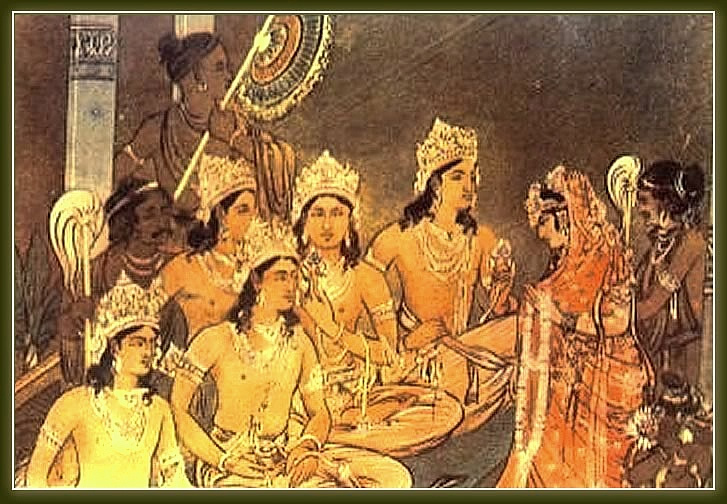
of the Pândavas on this page is from the indian painter Nanda Lal Bose. Source.
and the picture of Dhritarâshthra is part of a painting of the
indian artist Raja Ravi
Varma.
Production: Filognostic Association of The Order of Time.

Feed-back | Links | Downloads | Music | Pictures | What's New | Search | Donations



 Text 1-2