
Canto 10
Canto 10
Chapter 54: Rukmî's Defeat and Krishna Married
(1) S'rî S'uka said: 'And so they all [realizing that they had been robbed], most angrily and in armor, mounted their vehicles and with their bows ready, each surrounded by his own troops, went after Them. (2) When the Yâdava army noticed that they were being followed, the officers stopped to face them, oh King, and twanged their bows. (3) From the backs of their horses, the shoulders of their elephants and the seats of their chariots, the [enemy] masters of arms released a rain of arrows the way the clouds release their water over the mountains. (4) The moment the slender-waisted girl saw the army of her Lord being covered by heavy rains of arrows, she embarrassed looked at His face with eyes full of fear. (5) The Supreme Lord laughed and said: 'Do not be afraid, oh you with your beautiful eyes, your troops will destroy this enemy force right now.' (6) The heroes Gada [Krishna's younger half-brother], Sankarshana and the others, could not tolerate the display of power of the enemy forces, and thus they struck their horses, elephants and chariots down with arrows of iron. (7) The heads of those riding the chariots, the horses and the elephants, fell by the thousands to the ground, complete with earrings, helmets and turbans. (8) One could see the heads of horses, donkeys, mules, elephants and camels, as also [loose] heads of humans, clubs and bows, hands with swords, hands without fingers, thighs and legs. (9) The kings headed by Jarâsandha who, eager for the victory, saw that their armies were annihilated by the Vrishnis, lost their courage and left. (10) They approached and addressed S'is'upâla who, with the wife of his choice being stolen away, was dispirited and perturbed with a dried up face that had lost all its color. (11) [Jarâsandha said:] 'Oh Sir, tiger among men, please give up your gloom, for the embodied beings there is no permanence of desirable or undesirable matters. (12) The way a woman that is made of wood dances to the desire of a puppeteer, this world, which is concerned with joy and sorrow, is controlled by the Lord. (13) I myself with twenty-three armies have lost seventeen battles with S'auri [Krishna]. Only one I have won. (14) Nevertheless I never lament or rejoice, for I know that the world is driven by Time and fate combined. (15) Also now we all, leaders of the commanders of heroes, have been defeated by Yadus with a meager entourage who were protected by Krishna. (16) Our enemies, with the time in their favor, have won now, but then again, when our time has come, we will win.'
(17) S'rî S'uka said: 'S'is'upâla, thus persuaded by his friends, went back to his city with his company, and so too each of the surviving kings returned to his own place. (18) The mighty Rukmî however, who hated Krishna and could not bear the fact that his sister got married in the râkshasa style, pursued Krishna surrounded by an entire akshauhinî. (19-20) Rukmî, mighty armed with his bow and armor, most angrily full of resentment swore to all the kings listening: 'Let me tell you this: I truly will not return to Kundina without having killed Krishna in battle and having retrieved Rukminî.' (21) After having said this, he climbed on his chariot and told his charioteer: 'Quickly, drive the horses to the place where Krishna is found, there must be a fight between Him and me. (22) Today I, with my sharp arrows, will break the pride of that evil-minded Cowherd who so violently abducted my sister!'
(23) Thus vaunting foolishly he, not realizing what the Lord was all capable of, thereupon with a single chariot came forward and shouted at Krishna: 'Stand still, stop!' (24) Drawing his bow he most firmly struck Krishna with three arrows and said: 'Wait a minute, You corrupter of the Yadu dynasty! (25) Where do You think You are going, having stolen my sister like a crow stealing the sacrificial butter? Today I will put an end to Your false pride, You foolish cheater, You devious fighter! (26) If You do not want my arrows to kill You, lay off and release the girl'. But Krishna smiled and struck Rukmî with six arrows that broke his bow. (27) After Krishna had fired eight arrows at his four horses, two at his charioteer and three at his flagpole, he took up another bow and struck Krishna with five arrows. (28) Even though He was struck by all these arrows, Krishna broke his bow again, and when Rukmî picked up yet another one, Acyuta also broke that one. (29) The spiked bludgeon, the trident, the lance, the shield and sword, the pike, the javelin or whatever weapon he took up, were all broken by Him, the Lord. (30) He then leaped from his chariot and ran, sword in hand and as furious as a bird in the wind, forward with the intent to kill Krishna. (31) With His arrows Krishna broke the sword and shield of His attacker to pieces and next, ready to kill Rukmî, took up His own sharp sword. (32) When the saintly Rukminî saw that He wanted to kill her brother, she, beset with fear, fell at the feet of her husband and spoke piteously.
(33) S'rî Rukminî said: 'Oh Lord of Yoga, oh Inscrutable Soul, oh God of Gods, oh Master of the Universe, oh Auspicious One, please do not kill my brother, oh Mighty-armed One.'
(34) S'rî S'uka said: 'As she, with her limbs trembling with fear, her mouth dry of sorrow, her throat choked and her golden necklace disheveled in her agitation, was holding His feet, He desisted out of compassion. (35) He tied him up with a piece of cloth and shaved him, making a mess of him with only little bits of his hair and mustache remaining. Meanwhile the amazing army of the Yadu heroes crushed their opponents the way elephants crush a lotus flower [compare 1.7]. (36) When the Yadu soldiers approached Krishna they found Rukmî in a sorry condition, as good as dead. The almighty Supreme Lord Sankarshana, feeling pity, thereupon released him from his ties and said to Krishna: (37) 'Oh Krishna, what a terribly bad shaving job You have done with his mustache and hair! Disfiguring a family member like this equals to killing him!'
(38) [To Rukminî:] 'Oh saintly lady, please be in your care not angry with Us for making such a mess of your brother. For one’s happiness and grief no one else can be held accountable. A human being after all has to face the consequences of his own actions.' [*]
(39) [And to Krishna again:] 'Even though a relative because of his wrongdoing may deserve to be killed, he should not be killed by a relative but rather be banned [from the family]. Why should he who because of his evil deeds ended his own [honorable] life, be killed a second time?'
(40) [To Rukminî:] 'The code of conduct for warriors, as established by the founding father [Brahmâ], is that a brother must not even hesitate to kill his own brother. And that indeed is something most dreadful.'
(41) [Back to Krishna again:] 'Blinded as they are in their infatuation with the wealth, those who are proud of a kingdom, land, riches, women, honor, power or something else [other than the soul], do therefore commit offenses.'
(42) [And to Rukminî again:] 'In this attitude of you toward all living beings, of always wishing evil to foes and wishing good to friends [and family], you are just as partial as an ignorant person. (43) Because of the Lord's illusory power the people are bewildered about the Real Self [the soul]. [In mâyâ] taking the body for their self, they speak in terms of having a friend, an enemy or someone neutral. (44) Being bewildered one perceives the One and Only Supreme Soul of Every Inanimate and Animate Being as many, just like seeing different luminaries [in stead of one radiating fire] or considering the air [as different in case of an enclosed space, see also B.G. 18: 20-21 and 1.2: 32]. (45) The physical body having a beginning and an end is composed of the physical elements, the senses and the basic qualities of nature. In a state of ignorance it is something [that by conditioning is] imposed on the soul and produces [the experience of] the cycle of birth and death. (46) For the soul [who knows though] there is no oneness with or separation from anything material in the manifest world, oh chaste one, since matter is caused and arranged by the soul. It is like the perceiving and that what is perceived with the sun [which cannot separate from or unite with the manifest world]. (47) Being born and such are but transformations of the body and not of the soul, just as the lunar phases do not imply that the moon has died on the day of a new moon [see B.G. 2: 20]. (48) An unintelligent person undergoes his material existence the way a sleeping person, for the purpose of the unreality [of a dream], experiences himself, the objects of his senses and the results of his actions [see also 6.16: 55-56]. (49) Oh you with the pristine smile, please be therefore yourself again [as the goddess of fortune] and dispel, with the knowledge of the essence, the sadness born from ignorance that drained and confused you.'
(50) S'rî S'uka said: 'Slender-waisted Rukminî thus being enlightened by the Supreme Lord Balarâma, gave up her resignation and with intelligence regained her composure. (51) Left with only his life air, expelled by his enemies and deprived of his strength and luster, he [Rukmî] had to think constantly of the way he had been misshapen. Frustrated in his personal desires he then built a residence, a city named Bhojakatha ['having experienced the vow']. (52) Because he had said: 'I will not return to Kundina without having killed the evil-minded Krishna and having brought back my sister', he in his anger resided at that very spot [where he was humiliated]. (53) The Supreme Lord, thus defeating the earthly rulers, took the daughter of Bhîshmaka to His capital and married her according to the vidhi, oh protector of the Kurus. (54) To that occasion there was a great rejoicing among the citizens in each and every home of the Yadu city, oh King, where no one else but Krishna, the leader of the Yadus, was the great love. (55) The men and women, filled with joy, with shining jewels and earrings, respectfully presented wedding gifts to the celebrated couple that was exquisitely dressed. (56) The city of the Vrishnis appeared beautifully with the festive columns that were erected, the variety of flower garlands, the banners, the gems, the arches and at every doorway an arrangement of auspicious items like pots full of water, aguru incense and lamps. (57) It's streets were sprinkled and the entrances were beautified with plantain and betel nut stems that were placed by elephants, dripping with mada, belonging to the popular personalities who were invited. (58) The members of the Kuru, Sriñjaya, Kaikeya, Vidarbha, Yadu and Kunti families enjoyed the occasion of being together in the midst of the people who excitedly ran about. (59) When they heard about the kidnapping of Rukminî, which was being sung all around, the kings and their daughters were greatly impressed. (60) Oh King, all the citizens in Dvârakâ were overjoyed to see Krishna, the Master of All Opulence, joined in marriage with Rukminî, the goddess of fortune.'


Third revised edition, loaded April 29, 2021.
Previous Aadhar edition and Vedabase links:
S'rî S'uka said: 'And so they all [realizing that they had been robbed], most angrily and in armor, mounted their vehicles and with their bows ready, each surrounded by his own troops, went after Them.S'rî S'uka said: 'They all thus [realizing their being robbed] most angry in armor mounted their means of transport and came, each surrounded by his own troops, after them, holding their bows. (Vedabase)
When the Yâdava army noticed that they were being followed, the officers stopped to face them, oh King, and twanged their bows.
When the Yâdava army spotted them in their pursuit, held the officers to face them, o King, and twanged they their bows. (Vedabase)
From the backs of their horses, the shoulders of their elephants and the seats of their chariots, the [enemy] masters of arms released a rain of arrows the way the clouds release their water over the mountains.
From horseback, elephant shoulders and from the chariot seats released those [enemy] masters of arms clouds of arrows that rained like water does over the mountains. (Vedabase)
The moment the slender-waisted girl saw the army of her Lord being covered by heavy rains of arrows, she embarrassed looked at His face with eyes full of fear.
When the slender-waisted girl saw the army of her Lord covered by heavy rains of arrows looked she embarrassed at His face with eyes full of fear. (Vedabase)
The Supreme Lord laughed and said: 'Do not be afraid oh you with your beautiful eyes, your troops will destroy this enemy force right now.'
The Supreme Lord laughed and said: 'Don't be afraid, o beautiful eyes, right now will this enemy force be destroyed by your troops'. (Vedabase)
The heroes Gada [Krishna's younger half-brother], Sankarshana and the others, could not tolerate the display of power of the enemy forces, and thus they struck their horses, elephants and chariots down with arrows of iron.
The heroes Gada [Krishna's younger half-brother], Sankarshana and the others could not tolerate the display of power of the enemy forces and thus struck they with arrows of iron down the horses, elephants and chariots. (Vedabase)
The heads of those riding the chariots, the horses and the elephants, fell by the thousands to the ground, complete with earrings, helmets and turbans.
Of those riding the chariots, the horses and the elephants fell by the thousands the heads to the ground complete with earrings, helmets and turbans. (Vedabase)
One could see the heads of horses, donkeys, mules, elephants and camels, as also [loose] heads of humans, clubs and bows, hands with swords, hands without fingers, thighs and legs.
There were the heads of humans, horses, donkeys, mules, elephants and camels as well as [loose] hands with swords, clubs and bows, hands without fingers, thighs and legs. (Vedabase)
The kings headed by Jarâsandha who, eager for the victory, saw that their armies were annihilated by the Vrishnis, lost their courage and left.
The kings headed by Jarâsandha who eager for the victory saw their armies annihilated by the Vrishnis, then left discouraged. (Vedabase)
They approached and addressed S'is'upâla who, with the wife of his choice being stolen away, was dispirited and perturbed with a dried up face that had lost all its color.
They approached and addressed S'is'upâla who with the wife he had in mind being stolen away, dispirited was perturbed with a dried up face with all its color gone. (Vedabase)
[Jarâsandha said:] 'Oh Sir, tiger among men, please give up your gloom, for the embodied beings there is no permanence of desirable or undesirable matters.
[Jarâsandha said:] 'O Sir, tiger among men, please give up this dark state of mind, for the embodied ones is there to the wanted and unwanted no permanence to be found. (Vedabase)
The way a woman that is made of wood dances to the desire of a puppeteer, this world, which is concerned with joy and sorrow, is controlled by the Lord.
As a woman made of wood dances to the desire of a puppeteer is the same way this world, concerned with joy and sorrow, controlled by its Controller. (Vedabase)
I myself with twenty-three armies have lost seventeen battles with S'auri [Krishna]. Only one I have won.
I myself with twenty-three armies lost seventeen times over in battles with S'auri [Krishna] and only one I won. (Vedabase)
Nevertheless I never lament or rejoice, for I know that the world is driven by Time and fate combined.
Nonetheless do I never lament or rejoice, knowing that the world is driven by time and fate combined. (Vedabase)
Also now we all, leaders of the commanders of heroes, have been defeated by Yadus with a meager entourage who were protected by Krishna.
Even now are we all, leaders of the leaders of heroes, defeated by the meager entourage of Yadus under the protection of Krishna. (Vedabase)
Our enemies, with the time in their favor, have won now, but then again, when our time has come, we will win.'
Now, with our enemies having conquered, works the time in their favor but then again shall we conquer when the times have changed to our favor.' (Vedabase)
S'rî S'uka said: 'S'is'upâla, thus persuaded by his friends, went back to his city with his company, and so too each of the surviving kings returned to his own place.
S'rî S'uka said: 'Thus persuaded by his friends went S'is'upâla back to his city and so did also each of the surviving kings who followed him return to his own place. (Vedabase)
The mighty Rukmî however, who hated Krishna and could not bear the fact that his sister got married in the râkshasa style, pursued Krishna surrounded by an entire akshauhinî.
The mighty Rukmî however, who hating Krishna couldn't bear the fact that his sister got married in the râkshasa style, pursued Krishna surrounded by an entire akshauhinî. (Vedabase)
Rukmî, mighty armed with his bow and armor, most angrily full of resentment swore to all the kings listening: 'Let me tell you this: I truly will not return to Kundina without having killed Krishna in battle and having retrieved Rukminî.'
Rukmî, mighty armed with his bow and armor, most angrily full of resentment swore to all the kings listening: 'Let me tell you this in truth: I will not return to Kundina without having killed Krishna in battle and having retreived Rukminî'. (Vedabase)
After having said this, he climbed on his chariot and told his charioteer: 'Quickly, drive the horses to the place where Krishna is found, there must be a fight between Him and me.
Thus speaking climbed he his chariot and told he his charioteer: 'Quickly, drive the horses to where Krishna is, there must be a fight between Him and me. (Vedabase)
Today I, with my sharp arrows, will break the pride of that evil-minded Cowherd who so violently abducted my sister!'
Today will I, with my sharp arrows, baffle the madness of that most wicked Cowherd who had the temerity to violently abduct my sister!' (Vedabase)
Thus vaunting foolishly he, not realizing what the Lord was all capable of, thereupon with a single chariot came forward and shouted at Krishna: 'Stand still, stop!'
Thus foolishly vaunting not realizing what Krishna was all capable of, shouted he next with a single chariot coming forward at Krishna: 'Stand and fight!' (Vedabase)
Drawing his bow he most firmly struck Krishna with three arrows and said: 'Wait a minute, You corrupter of the Yadu dynasty!
Drawing his bow he most firmly struck Krishna [His chariot] with three arrows and said: 'Wait a minute, You corrupter of the Yadu-dynasty! (Vedabase)
Where do You think You are going, having stolen my sister like a crow stealing the sacrificial butter? Today I will put an end to Your false pride, You foolish cheater, You devious fighter!
Wherever You might go having stolen my sister like being a crow who steals the sacrificial butter, I'll put an end today to Your false pride, You foolish cheater, You devious fighter!! (Vedabase)
If You do not want my arrows to kill You, lay off and release the girl'. But Krishna smiled and struck Rukmî with six arrows that broke his bow.
If You want my arrows not to kill You, lay off and release the girl', but Krishna with a smile struck Rukmî with six arrows that broke his bow. (Vedabase)
After Krishna had fired eight arrows at his four horses, two at his charioteer and three at his flagpole, he took up another bow and struck Krishna with five arrows.
With Krishna firing eight arrows at his four horses, with two at his charioteer and with three at his flagpole, took he up another bow and struck he Krishna with five. (Vedabase)
Even though He was struck by all these arrows, Krishna broke his bow again, and when Rukmî picked up yet another one, Acyuta also broke that one.
Even though He was struck by all of these arrows broke Krishna, the Infallible One, his bow again just as another one that he picked up. (Vedabase)
The spiked bludgeon, the trident, the lance, the shield and sword, the pike, the javelin or whatever weapon he took up, were all broken by Him, the Lord.
The spiked bludgeon, the trident, the lance, the shield and sword, the pike, the javelin or whatever weapon he took up were all by Him, the Lord, broken. (Vedabase)
He then leaped from his chariot and ran, sword in hand and as furious as a bird in the wind, forward with the intent to kill Krishna.
Then leaping from his chariot sword in hand ran he, with the intent to kill Krishna, forward as furious as a bird in the wind. (Vedabase)
With His arrows Krishna broke the sword and shield of His attacker to pieces and next, ready to kill Rukmî, took up His own sharp sword.
With His arrows breaking to pieces the sword and shield of His attacker, took He, prepared to kill Rukmî, up His own sharp sword. (Vedabase)
When the saintly Rukminî saw that He wanted to kill her brother, she, beset with fear, fell at the feet of her husband and spoke piteously.
Seeing that He wanted to kill her brother fell the saintly Rukminî beset in fear at the feet of her husband and pleaded she piteously. (Vedabase)
S'rî Rukminî said: 'Oh Lord of Yoga, oh Inscrutable Soul, oh God of Gods, oh Master of the Universe, oh Auspicious One, please do not kill my brother, oh Mighty-armed One.'
S'rî Rukminî said: 'O Controller of Yoga, o Inscrutable Soul, o God of Gods, o Master of the Universe, o Auspicious One, please don't kill my brother, o Mighty-armed One.' (Vedabase)
S'rî S'uka said: 'As she, with her limbs trembling with fear, her mouth dry of sorrow, her throat choked and her golden necklace disheveled in her agitation, was holding His feet, He desisted out of compassion.
S'rî S'uka said: 'With His feet held by her whose limbs were trembling in total fear, with her mouth dry of sorrow, her throat choked and her golden necklace disheveled in her agitation, desisted He in compassion. (Vedabase)
He tied him up with a piece of cloth and shaved him, making a mess of him with only little bits of his hair and mustache remaining. Meanwhile the amazing army of the Yadu heroes crushed their opponents the way elephants crush a lotus flower [compare 1.7].
With a strip of cloth tying him up, shaved He the evildoer, making a mess of him leaving him but some of his hair and mustache. Meanwhile crushed the extraordinary army of the Yadu heroes their opponents the way elephants crush a lotus flower [compare 1.7]. (Vedabase)
When the Yadu soldiers approached Krishna they found Rukmî in a sorry condition, as good as dead. The almighty Supreme Lord Sankarshana, feeling pity, thereupon released him from his ties and said to Krishna:
Getting close to where Krishna was found they there Rukmî in a sorry condition as good as dead. The almighty Supreme Lord Sankarshana, feeling pity, thereupon released the one bound up and said to Krishna: (Vedabase)
'Oh Krishna, what a terribly bad shaving job You have done with his mustache and hair! Disfiguring a family member like this equals to killing him!'
'How improper of You, o Krishna; this clipping of Yours, of his mustache and hair so badly, is as terrible as the death of a family member!' (Vedabase)
[To Rukminî:] 'Oh saintly lady, please be in your care not angry with Us for making such a mess of your brother. For one’s happiness and grief no one else can be held accountable. A human being after all has to face the consequences of his own actions.' [*]
[To Rukminî:] 'O saintly lady, please don't be angry with Us making such a mess of your brother; there is to the matter of who brings happiness and grief no one else responsible but the person in question, since everyone has to face the consequences of his own actions.' (Vedabase)
[And to Krishna again:] 'Even though a relative because of his wrongdoing may deserve to be killed, he should not be killed by a relative but rather be banned [from the family]. Why should he who because of his evil deeds ended his own [honorable] life, be killed a second time?'
[And to Krishna again:] 'Even though a relative because of his wrongdoing deserves to be killed, should he by a relative not be killed, but instead be banned [from the family]; why should he who because of his evil deeds ended his own [honorable] life, be killed a second time?' (Vedabase)
[To Rukminî:] 'The code of conduct for warriors, as established by the founding father [Brahmâ], is that a brother must not even hesitate to kill his own brother. And that indeed is something most dreadful.'
[To Rukminî:] 'The sacred code of warriors as established by the founding father [Brahmâ] is that a brother even mustn't hesitate to kill his own brother. And that indeed is something most dreadful.' (Vedabase)
[Back to Krishna again:] 'Blinded as they are in their infatuation with the wealth, those who are proud of a kingdom, land, riches, women, honor, power or something else [other than the soul], do therefore commit offenses.'
[Back to Krishna again:] 'Those being proud of a kingdom, land, riches, women, honor and power or something else [other than the soul] do, blinded as they are in their infatuation about the opulence, for that reason indeed commit offenses.' (Vedabase)
[And to Rukminî again:] 'In this attitude of you toward all living beings, of always wishing evil to foes and wishing good to friends [and family], you are just as partial as an ignorant person.
[And to Rukminî again:] 'In this attitude of yours toward all living beings, of wishing evil to the ones inimical and good to well-wishers, are you as partial as any ignoramus. (Vedabase)
Because of the Lord's illusory power the people are bewildered about the Real Self [the soul]. [In mâyâ] taking the body for their self, they speak in terms of having a friend, an enemy or someone neutral.
By the illusory power of God is effected that people in their ways are bewildered about the Real Self so that they, who thus take the body for the soul, speak in terms of having a friend, an enemy or someone neutral. (Vedabase)
Being bewildered one perceives the One and Only Supreme Soul of Every Inanimate and Animate Being as many, just like seeing different luminaries [in stead of one radiating fire] or considering the air [as different in case of an enclosed space, see also B.G. 18: 20-21 and 1.2: 32].
Those who are bewildered perceive the One and Only Supreme Soul of each and all embodied being as being many, just like one does with the stars [not recognized as a cohering galaxy] or the air [seen as different for an enclosed space, see also B.G. 18: 20-21 and 1.2: 32]. (Vedabase)
The physical body having a beginning and an end is composed of the physical elements, the senses and the basic qualities of nature. In a state of ignorance it is something [that by conditioning is] imposed on the soul and produces [the experience of] the cycle of birth and death.
The physical body having a beginning and an end is composed of the physical elements, the senses and the modes of nature. Because of material ignorance is it something imposed upon the self and is it thus the cause of experiencing the cycle of birth and death. (Vedabase)
For the soul [who knows though] there is no oneness with or separation from anything material in the manifest world, oh chaste one, since matter is caused and arranged by the soul. It is like the perceiving and that what is perceived with the sun [which cannot separate from or unite with the manifest world].
For the soul in contact with anything else, o chaste one, is there no separation because of the originating from it [as with the individual soul] or untruth because of being revealed by it [as a physical form]; like it is also with the sun in relation to the seeing and the form seen. (Vedabase)
Being born and such are but transformations of the body and not of the soul, just as the lunar phases do not imply that the moon has died on the day of a new moon [see B.G. 2: 20].
Birth and such are but transformations of the body, never of the soul, just as the lunar phases do not imply that the moon has died on the day of a new moon. (Vedabase)
An unintelligent person undergoes his material existence the way a sleeping person, for the purpose of the unreality [of a dream], experiences himself, the objects of his senses and the results of his actions [see also 6.16: 55-56].
Like a sleeping person experiences himself, sense-objects and results of action even though they're not real, undergoes the same way an unintelligent person his material existence [see also 6.16: 55-56]. (Vedabase)
Oh you with the pristine smile, please be therefore yourself again [as the goddess of fortune] and dispel, with the knowledge of the essence, the sadness born from ignorance that drained and confused you.'
Therefore, o you with the pristine smile, please be yourself again [as the goddess of fortune] and dispell with the knowledge of the essence the sadness born of ignorance of which you dried up and were confounded.' (Vedabase)
S'rî S'uka said: 'Slender-waisted Rukminî thus being enlightened by the Supreme Lord Balarâma, gave up her resignation and with intelligence regained her composure.
S'rî S'uka said: 'The slender-waisted one thus enlightened by Balarâma, the Supreme Lord, gave up her despondency and regained her composure with intelligence. (Vedabase)
Left with only his life air, expelled by his enemies and deprived of his strength and luster, he [Rukmî] had to think constantly of the way he had been misshapen. Frustrated in his personal desires he then built a residence, a city named Bhojakatha ['having experienced the vow'].
Left with only his life air, expelled by his enemies and deprived of his strength and luster was he [Rukmî] unable to forget his humiliation. Frustrated in his personal desires he then built himself a residence. It became a large city named Bhojakatha ['having experienced the vow']. (Vedabase)
Because he had said: 'I will not return to Kundina without having killed the evil-minded Krishna and having brought back my sister', he in his anger resided at that very spot [where he was humiliated].
Having said 'Without killing the evil-minded Krishna, without retrieving my sister, I will not return to Kundina', took he angry right on that spot up his residence. (Vedabase)
The Supreme Lord, thus defeating the earthly rulers, took the daughter of Bhîshmaka to His capital and married her according to the vidhi, oh protector of the Kurus.
The Supreme Lord, thus defeating the earthly rulers, brought the daughter of Bhîshmaka to His capital and married her according the vidhi, o protector of the Kurus. (Vedabase)
To that occasion there was a great rejoicing among the citizens in each and every home of the Yadu city, oh King, where no one else but Krishna, the leader of the Yadus, was the great love.
To that occasion there was great rejoicing in each and every home of the Yadu city were, o King, the people had no one but Krishna, the leader of the Yadus, as their object of love. (Vedabase)
The men and women, filled with joy, with shining jewels and earrings, respectfully presented wedding gifts to the celebrated couple that was exquisitely dressed.
The men and women, joyful with shining jewels and earrings, respectfully presented wedding gifts to the ones celebrated, who were exquisitely dressed. (Vedabase)
The city of the Vrishnis appeared beautifully with the festive columns that were erected, the variety of flower garlands, the banners, the gems, the arches and at every doorway an arrangement of auspicious items like pots full of water, aguru incense and lamps.
The city of the Vrishnis appeared beautiful with the festive columns raised, the variety of flower garlands, the banners, the gems and the arches with at every doorway an arrangement of auspicious items as pots full of water, aguru incense and lamps. (Vedabase)
It's streets were sprinkled and the entrances were beautified with plantain and betel nut stems that were placed by elephants, dripping with mada, belonging to the popular personalities who were invited.
It's streets were sprinkled with the help of elephants dripping with mada who belonged to the popular personalities who were invited and at the doorways, to further enhance the beauty, were placed plantain and betelnut stems. (Vedabase)
The members of the Kuru, Sriñjaya, Kaikeya, Vidarbha, Yadu and Kunti families enjoyed the occasion of being together in the midst of the people who excitedly ran about.
The members of the Kuru, Sriñjaya, Kaikeya, Vidarbha, Yadu and Kunti families enjoyed the occasion of being together in the midst of the people who excitedly ran about. (Vedabase)
When they heard about the kidnapping of Rukminî, which was being sung all around, the kings and their daughters were greatly impressed.
Hearing about the kidnapping of Rukminî that was being sung all around, became the kings and their daughters greatly amazed. (Vedabase)
Oh King, all the citizens in Dvârakâ were overjoyed to see Krishna, the Master of All Opulence, joined in marriage with Rukminî, the goddess of fortune.'
O King, in Dvârakâ were all the citizens overjoyed to see Krishna, the Master of all Opulence joined in marriage with Rukminî, the goddess of fortune.' (Vedabase)*: This verse does not mean that it is meant that one should not be compassionate with forms of suffering as caused by oneself, by others or by natural occurrences, like one has with parasitical diseases, floods and earthquakes. Of course this 'karma blaming', to accuse someone of his fate, often considered a Hindu weakness, is a fundamental philosophical issue, for, on the one hand, each and everyone in the adult world is responsible for his own actions and the consequences thereof, while, on the other hand, someone else or nature can also cause a lot of grief to the innocent. All three cases in fact in Vedic philosophy constitute hindrances, so-called kles'sas, constituting a fate that needs to be overcome by yogic discipline and devotional service. In this verse evidently the adult responsibility for one's own actions is meant. Also is shown, by Krishna's shaving act and also other acts of His forgiveness, that, when possible, even for murderous intent compassion should be exercised and not directly an eye-for-an-eye retribution.

The text and audio are offered under the
conditions of the
Creative
Commons Attribution-Noncommercial-Share Alike 3.0 Unported
License.
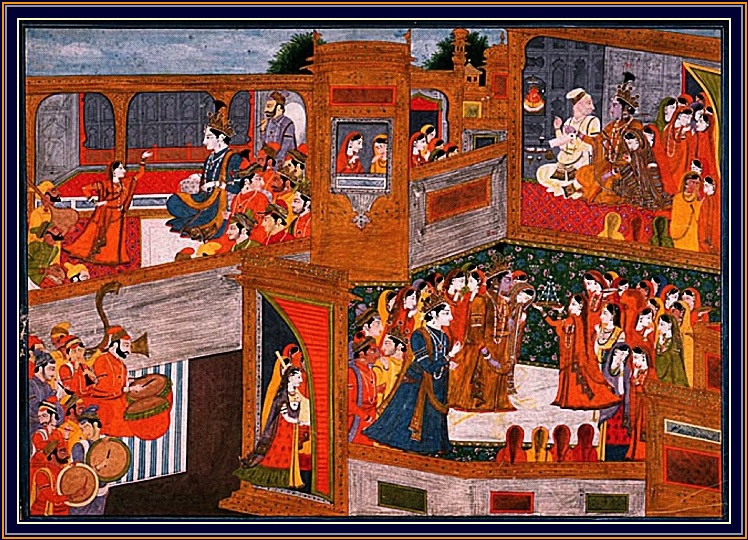
The picture is called: 'Marriage of Krishna and Rukmini'
Folio from a Rukmini-Harana (Abduction of Rukmini) India,
Himachal Pradesh, Guler, South Asia, circa 1800.
Courtesy of LACMA.
Production: Filognostic
Association of The Order of Time.

Feed-back | Links | Downloads | Music | Pictures | What's New | Search | Donations



 Text 1