
Canto 10
Canto 10
Chapter 74: The Râjasûya: Krishna Number One and S'is'upâla Killed
(1) S'rî S'uka said: 'King Yudhishthhira, thus hearing about the death of Jarâsandha and the display of power of the almighty Krishna, was pleased about it and addressed Him. (2) S'rî Yudhishthhira said: 'All the spiritual masters, inhabitants, and great rulers in the three worlds, carry the difficult to obtain command [of You] on their heads. (3) That You Yourself, the Lotus-eyed Lord, take directions from by the day living people [like us] who consider themselves controllers, is, oh All-pervading One, a great pretense [of you imitating our ways]. (4) The way it is with the movements of the sun, the power of the One without a Second, the Absolute Truth, the Supersoul, does not increase nor diminish by [His] activities [see B.G. 2: 40]. (5) Oh Mâdhava, the perverted animalistic mentality of making distinctions of 'I and mine' and 'you and yours', is truly not Yours, oh Unconquerable One, nor of Your bhaktas.'
(6) S'rî S'uka said: 'The son of Prithâ thus having spoken, with the permission of Krishna chose, at a proper time for the sacrifice, the priests who were suitable, brahmins who were Vedic experts: (7-9) Dvaipâyana [Vyâsa], Bharadvâja, Sumantu, Gotama, Asita, Vasishthha, Cyavana, Kanva, Maitreya, Kavasha, Trita, Vis'vâmitra, Vâmadeva, Sumati, Jaimini, Kratu, Paila, Parâs'ara, Garga, Vais'ampâyana as also Atharvâ, Kas'yapa, Dhaumya, Râma of the Bhârgavas [Pâras'urâma], Âsuri, Vîtihotra, Madhucchandâ, Vîrasena and Akritavrana. (10-11) Also others were invited like Drona, Bhîshma, Kripa, Dhritarâshthra with his sons and the highly intelligent Vidura. Kings with their royal entourages, brahmins, kshatriyas, vais'yas and s'ûdras, all came there eager to attend the sacrifice, oh King. (12) The brahmins with golden plowshares then furrowed the place for worshiping the gods, and inaugurated there the king according to the injunctions. (13-15) The utensils were golden, like it had been in the past when Varuna was of sacrifice [compare 9.2: 27]. The rulers of the worlds headed by Indra, including Brahmâ and S'iva, the perfected souls and the heavenly singers with their entourage, the scholars, the great serpents [vips, egos], the sages, the wealth keepers and the wild men, the birds of heaven [see khaga], the mighty ones, the venerable souls and the earthly kings, as also the wives of the kings who were invited, came from everywhere to the Râjasûya sacrifice which they, not surprised at all [about all the wealth], deemed quite appropriate for a devotee of Krishna. (16) The priests who were as powerful as the gods, performed the Râjasûya sacrifice for the great king as was Vedically prescribed, the way the demigods did it for Varuna. (17) On the day set for extracting t he soma juice, the king properly with great attention worshiped the sacrificers and the most exalted personalities of the assembly. (18) The members of the assembly pondered over who of them should be honored first, but could not arrive at a conclusion, because there were many [members who qualified]. Then Sahadeva [the Pândava] spoke up: (19) 'Acyuta deserves the supreme position, He is the Supreme Lord, the leader of the Sâtvatas. He stands for all the demigods as also for the place, the time and the paraphernalia, and such. (20-21) This universe as also the great sacrificial performances, the sacred fire, the oblations and the incantations are founded upon Him. The analytical perspective and the science of yoga are aiming at Him. He is the One and Only without a second upon whom the living being [the universe] is based, oh members of the assembly. He is the Unborn One relying on Himself only, who creates, maintains and destroys.(22) His grace brings about the various activities out here, and because of His grace the entire world endeavors for the ideals characterized by religiosity and such [the purusharthas]. (23) Therefore the greatest honor should be given to Krishna, the Supreme One. If we do that, we will be honoring all living beings, ourselves included. (24) It should be awarded to Krishna, the Soul of all beings who considers no one as separate from Himself, to the Peaceful One Perfectly Complete, who for anyone who wishes his love to be answered constitutes the Unlimited [of an Infinite Return].'
(25) After Sahadeva, well known with Krishna's dignity, thus had spoken, he fell silent, whereupon all the souls of excellence and truth who heard this, filled with happiness said: 'This is excellent, very fine!'
(26) Hearing the twice-born souls say this, the king, pleased to know the heart of the assembly, overwhelmed by love worshiped Hrishîkes'a in full. (27-28) He washed His feet and took the water that purifies the world on his head. Then he carried it joyfully to his wife, his brothers, his ministers and family. And, as he with precious yellow silken garments and jewelry honored Him, he could not look straight at Him because of the tears that filled his eyes. (29) Seeing Him honored this way, all the people with joined palms exclaimed: 'Obeisances to You, all victory to You!' and saying this, they bowed down to Him and showered Him with flowers.
(30) The son of Damaghosha [S'is'upâla, see 10.53] hearing this, aroused by the descriptions of Krishna's qualities, angrily rose from his seat waving with his arms and said, indignantly addressing the Fortunate One with harsh words, the following in the middle of the assembly: (31) 'The Vedic word of truth that Time is the unavoidable controller, has by this been proven, for even the intelligence of the elders could be led astray by the words of a boy! (32) You all know best who would be the most praiseworthy one! Please, oh leaders of the assembly, pay no attention to the statements of the boy that Krishna should be chosen to be honored. (33-34) You overlook the leaders in the assembly who are the best among the wise, who are dedicated to the Absolute Truth and are worshiped by the rulers over the planet. They are men who by spiritual understanding, austerity, Vedic knowledge and vows eradicated their impurities. How can a cowherd who is a disgrace to His family, deserve it to be worshiped? He deserves it no more than a crow deserves the sacred rice cake! (35) How can He who, engaging of His own accord, acts outside the bounds of all religious duties, devoid of kula [a proper upbringing] varna [vocational propriety] and âs'rama [sense of duty according to one's age], thus missing the qualities, deserve it to be worshiped? (36) With His [Yadu-]dynasty cursed by Yayâti [see 9.18: 40-44], being ostracized by well-behaved persons [see 10.52: 9] and wantonly addicted to drinking [e.g. 10.67: 9-10], how can such a one deserve the worship? (37) Abandoning the lands [of Mathurâ] graced by the brahmin sages, He with His associates took to a fortress in the sea [10.50: 49] where the brahminical order is not observed [10.57: 30] and where they as thieves cause the people a lot of trouble [e.g. 10.61].'
(38) The Supreme Lord did not say a word to him who, using such and more harsh words, had spoilt all his chances. He kept silent like a lion to a jackal's cry. (39) Hearing that intolerable criticism, the members of the assembly covered their ears and walked away, while angrily cursing the king of Cedi. (40) A person who does not leave the place where the Supreme Lord or His devotee is criticized, loses his pious credit and will fall down. (41) Then the sons of Pându, as also the Matsyas, Kaikayas and Sriñjayas, stood up infuriated with raised weapons, prepared to kill S'is'upâla. (42) S'is'upâla, oh scion of Bharata, thereupon, undaunted, took up his sword and shield and challenged with insults the kings in the assembly who were the proponents of Krishna. (43) That very moment, the Supreme Lord stood up and stopped His devotees. Displeased He attacked His enemy with His sharp-edged disc and severed his head from his trunk. (44) With S'is'upâla being killed a tumultuous uproar rose from the audience. The kings siding with him feared for their lives and fled away. (45) Right before the eyes of everyone alive, from the body of S'is'upâla a light rose that entered Krishna, like it was a meteor falling from the sky to the earth [see also 10.12: 33]. (46) Throughout three lifetimes he had been obsessed with this mentality [of enmity], and thus meditating he [now finally] attained Oneness with Him [B.G. 4: 9, see also 10.12: 33]. It is indeed so that one's attitude is the cause of one's rebirth [see B.G. 8: 6 & Jaya and Vijaya]. (47) The emperor rewarded the priests and the members of the assembly abundantly with gifts, respecting them all properly according to the scriptural injunctions, and next performed the avabhritha ceremony [of washing himself and the utensils to conclude the sacrifice]. (48) Krishna, the Master of all Yoga Masters, saw to it that the great sacrifice of the king was concluded and stayed, on the request of His well-wishers, a couple of months more [in Indraprastha]. (49) The son of Devakî, Îs'vara, then took leave from the king - who did not feel for it at all - and together with His wives and ministers went back to His city. (50) The story of the two Vaikunthha residents who, because of a curse of the sages [the Kumâras], had to take birth repeatedly, I have related to you in great detail [see 3.16]. (51) When King Yudhishthhira bathed at the avabhritha of the Râjasûya, he, in the midst of the brahmins and kshatriyas, shone as brilliant as the king of the demigods. (52) All the gods, human beings and travelers of the sky [the lesser gods, the Pramathas], being honored by the king, happily returned to their domains, full of praise for Krishna and the sacrifice. (53) [All were happy], except for the sinful Duryodhana, who was the pest of the Kuru dynasty and the personification of the Age of Quarrel. To face the flourishing opulence of the Pândavas was something he could not tolerate.
(54) He who recites these activities of Lord Vishnu, the deliverance of the kings, the [Râjasûya] sacrifice and the killing of the king of Cedi and such, is delivered from all sin.'


Third revised edition, loaded September 22, 2021.
Previous Aadhar edition and Vedabase links:
S'rî S'uka said: 'King Yudhishthhira, thus hearing about the death of Jarâsandha and the display of power of the almighty Krishna, was pleased about it and addressed Him.S'rî S'uka said: 'Yudhishthhira, the king, thus hearing of the death of Jarâsandha and the display of power of the almighty Krishna, pleased with that addressed Him. (Vedabase)
S'rî Yudhishthhira said: 'All the spiritual masters, inhabitants, and great rulers in the three worlds, carry the difficult to obtain command [of You] on their heads.
S'rî Yudhishthhira said: 'All the spiritual masters, inhabitants, and great controllers there are of the three worlds, carry the indeed rarely obtained command [of You] on their heads. (Vedabase)
That You Yourself, the Lotus-eyed Lord, take directions from by the day living people [like us] who consider themselves controllers, is, oh All-pervading One, a great pretense [of you imitating our ways].
That He, the Lotus-eyed Lord Yourself, takes directions of those to the day living people [like us] who presume themselves to be controllers, is, o All-pervading One, the greatest annoyance. (Vedabase)
The way it is with the movements of the sun, the power of the One without a Second, the Absolute Truth, the Supersoul, does not increase nor diminish by [His] activities [see B.G. 2: 40].
Like with the sun indeed, does of the One without a Second, the Absolute Truth, the Supersoul, the power not increase nor diminish by [His] activities [see: B.G. 2: 40]. (Vedabase)
Oh Mâdhava, the perverted animalistic mentality of making distinctions of 'I and mine' and 'you and yours', is truly not Yours, oh Unconquerable One, nor of Your bhaktas.'
O Mâdhava, the perverted mentality of setting apart 'you and yours' and 'I and mine', as if one is of the animals, is verily not Yours, o Unconquerable One, nor of your bhaktas.' (Vedabase)
S'rî S'uka said: 'The son of Prithâ thus having spoken, with the permission of Krishna chose, at a proper time for the sacrifice, the priests who were suitable, brahmins who were Vedic experts:
S'rî S'uka said: 'Thus having spoken chose the son of Prithâ, at the right time for the sacrifice, with the permission of Krishna the priests who were suitable, the brahmins who were vedic experts: (Vedabase)
Dvaipâyana [Vyâsa], Bharadvâja, Sumantu, Gotama, Asita, Vasishthha, Cyavana, Kanva, Maitreya, Kavasha, Trita, Vis'vâmitra, Vâmadeva, Sumati, Jaimini, Kratu, Paila, Parâs'ara, Garga, Vais'ampâyana as also Atharvâ, Kas'yapa, Dhaumya, Râma of the Bhârgavas [Pâras'urâma], Âsuri, Vîtihotra, Madhucchandâ, Vîrasena and Akritavrana.
Dvaipâyana [Vyâsa], Bharadvâja, Sumantu, Gotama, Asita, Vasishthha, Cyavana, Kanva, Maitreya, Kavasha, Trita, Vis'vâmitra, Vâmadeva, Sumati, Jaimini, Kratu, Paila, Parâs'ara, Garga, Vais'ampâyana as also Atharvâ, Kas'yapa, Dhaumya, Râma of the Bhârgavas [Pâras'urâma], Âsuri, Vîtihotra, Madhucchandâ, Vîrasena and Akritavrana. (Vedabase)
Also others were invited like Drona, Bhîshma, Kripa, Dhritarâshthra with his sons and the highly intelligent Vidura. Kings with their royal entourages, brahmins, kshatriyas, vais'yas and s'ûdras, all came there eager to attend the sacrifice, oh King.
Also invited were others like Drona, Bhîshma, Kripa and Dhritarâshthra with his sons, and the highly intelligent Vidura; kings with their royal entourages, brahmins, kshatriyas, vais'yas and s'ûdras, all came there eager to attend the sacrifice, o King. (Vedabase)
The brahmins with golden plowshares then furrowed the place for worshiping the gods, and inaugurated there the king according to the injunctions.
Then furrowed the brahmins with plowshares of gold the place of worshiping the gods and inaugurated they there the king according the injunctions. (Vedabase)
The utensils were golden, like it had been in the past when Varuna was of sacrifice [compare 9.2: 27]. The rulers of the worlds headed by Indra, including Brahmâ and S'iva, the perfected souls and the heavenly singers with their entourage, the scholars, the great serpents [vips, egos], the sages, the wealth keepers and the wild men, the birds of heaven [see khaga], the mighty ones, the venerable souls and the earthly kings, as also the wives of the kings who were invited, came from everywhere to the Râjasûya sacrifice which they, not surprised at all [about all the wealth], deemed quite appropriate for a devotee of Krishna.
The utensils were of gold like it had been in the past when Varuna sacrificed [compare 9.2: 27]. The rulers of the worlds headed by Indra, including Brahmâ and S'iva; the perfected and heavenly singers with their entourage; the scholars, the great serpents [v.i.p.s, egos], the sages, the wealth keepers and wild men; the birds of heaven [see khaga], the mighty, the venerable and the earthly kings who were invited, as also the wives of the kings came from everywhere to the Râjasûya sacrifice which they, not being surpised, for a devotee of Krishna deemed quite appropriate. (Vedabase)
The priests who were as powerful as the gods, performed the Râjasûya sacrifice for the great king as was Vedically prescribed, the way the demigods did it for Varuna.
The priests who were as powerful as the gods performed for the great king the Râjasûya sacrifice as was vedically prescribed, exactly the way the demigods had done it for Varuna. (Vedabase)
On the day set for extracting the soma juice, the king properly with great attention worshiped the sacrificers and the most exalted personalities of the assembly.
On the day for extracting the soma-juice worshiped the king very attentively the sacrificers and the exalted personalities of the assembly. (Vedabase)
The members of the assembly pondered over who of them should be honored first, but could not arrive at a conclusion, because there were many [members who qualified]. Then Sahadeva [the Pândava] spoke up:
The members seated in the assembly pondering over who of them deserved to be worshiped first could not arrive at a conclusion because there were many [who qualified]; then Sahadeva [the Pândava] spoke up: (Vedabase)
'Acyuta deserves the supreme position, He is the Supreme Lord, the leader of the Sâtvatas. He stands for all the demigods as also for the place, the time and the paraphernalia, and such.
'Acyuta for sure deserves the supreme position, He is the Supreme Lord, the leader of the Sâtvatas, He doubtlessly covers all the demigods as well as the place, time and necessities and such. (Vedabase)
This universe as also the great sacrificial performances, the sacred fire, the oblations and the incantations are founded upon Him. The analytical perspective and the science of yoga are aiming at Him. He is the One and Only without a second upon whom the living being [the universe] is based, oh members of the assembly. He is the Unborn One relying on Himself only, who creates, maintains and destroys.
This universe as well as the great sacrificial performances, the sacred fire, the oblations and the incantations are founded upon Him and the analytical perspective and the yoga are aiming at Him. He is the One alone without a second upon whom the Living Being builds, the Unborn One relying on Himself alone, o members of the assembly, who creates, maintains and destroys. (Vedabase)
His grace brings about the various activities out here, and because of His grace the entire world endeavors for the ideals characterized by religiosity and such [the purusharthas].
He generates the various activities out here; to His grace does the whole world endeavor and follow its ideals known as the religiosity and so on [the purusharthas]. (Vedabase)
Therefore the greatest honor should be given to Krishna, the Supreme One. If we do that, we will be honoring all living beings, ourselves included.
Therefore should the greatest honor be given to Krishna, the Supreme One; if we do it this way, will we be honoring all living beings as well as ourselves. (Vedabase)
It should be awarded to Krishna, the Soul of all beings who considers no one as separate from Himself, to the Peaceful One Perfectly Complete, who for anyone who wishes his love to be answered constitutes the Unlimited [of an Infinite Return].'
It is to be given to Krishna, the Soul of all beings who sees no one as separate from Himself; to the One of Peace Perfectly Complete who for one who wishes his love to be reciprocated, is the Unlimited [the Infinite of Return].' (Vedabase)
After Sahadeva, well known with Krishna's dignity, thus had spoken, he fell silent, whereupon all the souls of excellence and truth who heard this, filled with happiness said: 'This is excellent, very fine!'
Sahadeva thus speaking fell silent and all the ones of excellence and truth who heard this and had awoken to the influence of Krishna said happily: 'This is excellent, very fine!' (Vedabase)
Hearing the twice-born souls say this, the king, pleased to know the heart of the assembly, overwhelmed by love worshiped Hrishîkes'a in full.
Hearing what the twiceborn pronounced, worshiped the king overwhelmed by love Hrishîkes'a fully, glad to know that the members of the assembly were content. (Vedabase)
He washed His feet and took the water that purifies the world on his head. Then he carried it joyfully to his wife, his brothers, his ministers and family. And, as he with precious yellow silken garments and jewelry honored Him, he could not look straight at Him because of the tears that filled his eyes.
Washing His feet and taking the water that purifies the world on his own head, carried he it with pleasure to his wife, his brothers, his ministers and family. And as he with precious yellow silken garments and jewelry was honoring Him, could he, with the tears filling his eyes, not look Him straight in His face. (Vedabase)
Seeing Him honored this way, all the people with joined palms exclaimed: 'Obeisances to You, all victory to You!' and saying this, they bowed down to Him and showered Him with flowers.
Seeing Him honored this way exclaimed all the people with joined palms: 'Obeisances to You, all victory to You!' and to that they bowed down to Him and showered they Him with flowers. (Vedabase)
The son of Damaghosha [S'is'upâla, see 10.53] hearing this, aroused by the descriptions of Krishna's qualities, angrily rose from his seat waving with his arms and said, indignantly addressing the Fortunate One with harsh words, the following in the middle of the assembly:
The son of Damaghosha [S'is'upâla, see 10.53] hearing this rose, aroused by the descriptions of Krishna's qualities, from his seat angrily waving with his arms and said, resolutely addressing the Fortunate One with harsh words, this in the middle of the assembly: (Vedabase)
'The Vedic word of truth that Time is the unavoidable controller, has by this been proven, for even the intelligence of the elders could be led astray by the words of a boy!
'The vedic word of truth that Time is the unavoidable controller, has been proven true since even the intelligence of the elders could be led astray by the words of a boy! (Vedabase)
You all know best who would be the most praiseworthy one! Please, oh leaders of the assembly, pay no attention to the statements of the boy that Krishna should be chosen to be honored.
All of you very well know who would be the most praiseworthy; please, all you leaders of the assembly, pay no attention to the statements of the boy that Krishna should be chosen for being honored. (Vedabase)
You overlook the leaders in the assembly who are the best among the wise, who are dedicated to the Absolute Truth and are worshiped by the rulers over the planet. They are men who by spiritual understanding, austerity, Vedic knowledge and vows eradicated their impurities. How can a cowherd who is a disgrace to His family, deserve it to be worshiped? He deserves it no more than a crow deserves the sacred rice cake!
You overlook the leaders in the assembly who are the best among the wise. They, dedicated to the Absolute Truth, are held high by the local authorities, they are men who by spiritual understanding, austerity, vedic knowledge and vows eradicated their impurities. How can a cowherd, who is a disgrace to His family, deserve it to be worshiped? He deserves it no more than a crow deserves the sacred rice cake! (Vedabase)
How can He who, engaging of His own accord, acts outside the bounds of all religious duties, devoid of kula [a proper upbringing] varna [vocational propriety] and âs'rama [sense of duty according to one's age], thus missing the qualities, deserve it to be worshiped?
How can He, acting on His own accord and devoid of kula [a proper upbringing] varna [vocational propriety] and âs'rama [sense of duty to one's age], thus missing the qualities, deserve it to be worshiped? (Vedabase)
With His [Yadu-]dynasty cursed by Yayâti [see 9.18: 40-44], being ostracized by well-behaved persons [see 10.52: 9] and wantonly addicted to drinking [e.g. 10.67: 9-10], how can such a one deserve the worship?
With their [Yadu-]dynasty cursed by Yayâti [see 9.18: 40-44], being ostracized by well-behaved persons [see 10.52: 9] and wantonly addicted to drinking [e.g. 10.67: 9-10], how can such a one deserve the worship? (Vedabase)
Abandoning the lands [of Mathurâ] graced by the brahmin sages, He with His associates took to a fortress in the sea [10.50: 49] where the brahminical order is not observed [10.57: 30] and where they as thieves cause the people a lot of trouble [e.g. 10.61].'
Abandoning the lands [of Mathurâ] graced by the brahmin sages took these Ones to a fortress in the sea [10.50: 49] where the brahminical is not observed [10.57: 30], and where They as thieves give a lot of trouble to the people [e.g. 10.61].' (Vedabase)
The Supreme Lord did not say a word to him who, using such and more harsh words, had spoilt all his chances. He kept silent like a lion to a jackal's cry.
Before him who, with speaking such and more harsh words, had lost all his chances, spoke the Supreme Lord not a word. He kept silent like a lion to a jackal's cry. (Vedabase)
Hearing that intolerable criticism, the members of the assembly covered their ears and walked away, while angrily cursing the king of Cedi.
Hearing that intolerable criticism, covered the members of the assembly their ears and went they away cursing the king of Cedi angrily. (Vedabase)
A person who does not leave the place where the Supreme Lord or His devotee is criticized, loses his pious credit and will fall down.
A person dedicated to Him who does not leave the place where criticism of the Supreme Lord is heard, will, having lost his pious credit, fall down. (Vedabase)
Then the sons of Pându, as also the Matsyas, Kaikayas and Sriñjayas, stood up infuriated with raised weapons, prepared to kill S'is'upâla.
The sons of Pându, the Matsyas, Kaikayas and Sriñjayas then, infuriated raising their weapons, stood prepared to kill S'is'upâla. (Vedabase)
S'is'upâla, oh scion of Bharata, thereupon, undaunted, took up his sword and shield and challenged with insults the kings in the assembly who were the proponents of Krishna.
Thereupon, o scion of Bharata, took S'is'upâla undaunted up his sword and shield to challenge with insults the kings in the assembly who were the proponents of Krishna. (Vedabase)
That very moment, the Supreme Lord stood up and stopped His devotees. Displeased He attacked His enemy with His sharp-edged disc and severed his head from his trunk.
The Supreme Lord just then rising stopped His devotees and displeased attacked His enemy with His sharp-edged disc with which He severed his head. (Vedabase)
With S'is'upâla being killed a tumultuous uproar rose from the audience. The kings siding with him feared for their lives and fled away.
With S'is'upâla killed there was a tumultuous uproar among the audience, which thus offered the kings who sided with him and feared for their lives the opportunity to flee. (Vedabase)
Right before the eyes of everyone alive, from the body of S'is'upâla a light rose that entered Krishna, like it was a meteor falling from the sky to the earth
Right before the eyes of all the living rose from the body of S'is'upâla a light that entered Krishna like it was a meteor from the sky falling to earth [see also 10.12: 33]. (Vedabase)
Throughout three lifetimes he had been obsessed with this mentality [of enmity], and thus meditating he [now finally] attained Oneness with Him [B.G. 4: 9, see also 10.12: 33]. It is indeed so that one's attitude is the cause of one's rebirth [see B.G. 8: 6 & Jaya and Vijaya].
Extending throughout three lifetimes had he been obsessed by a mentality of enmity and attained he thus meditating Oneness with Him [B.G. 4: 9]. It is really so that one's attitude is the cause of one's rebirth! [see B.G. B.G. 8: 6 & Jaya and Vijaya] (Vedabase)
The emperor rewarded the priests and the members of the assembly abundantly with gifts, respecting them all properly according to the scriptural injunctions, and next performed the avabhritha ceremony [of washing himself and the utensils to conclude the sacrifice].
The emperor gave in gratitude the priests and the members of the assembly abundant gifts, respecting them all properly according the scriptural injunctions, and performed the avabhritha ceremony [of washing himself and the utensils to conclude the sacrifice]. (Vedabase)
Krishna, the Master of all Yoga Masters, saw to it that the great sacrifice of the king was concluded and stayed, on the request of His well-wishers, a couple of months more [in Indraprastha].
Krishna, the Controller of the Controllers of Yoga, seeing to it that the sacrifice of the king was performed, stayed a couple of months [in Indraprastha] on the request of His well-wishers. (Vedabase)
The son of Devakî, Îs'vara, then took leave from the king - who did not feel for it at all - and together with His wives and ministers went back to His city.
Then asking permission with a reluctant king, went the son of Devakî, Îs'vara, with His wives and ministers away to His own city. (Vedabase)
The story of the two Vaikunthha residents who, because of a curse of the sages [the Kumâras], had to take birth repeatedly, I have related to you in great detail [see 3.16].
The tale of the two Vaikunthha residents that due to the curse of the learned ones had to be born again and again, has by me been related to you in detail [see 3.16]. (Vedabase)
When King Yudhishthhira bathed at the avabhritha of the Râjasûya, he, in the midst of the brahmins and kshatriyas, shone as brilliant as the king of the demigods.
King Yudhishthhira in the midst of the brahmins and kshatriyas bathing at the avabhritha of the Râjasûya shone as brilliant as the king of the demigods. (Vedabase)
All the gods, human beings and travelers of the sky [the lesser gods, the Pramathas], being honored by the king, happily returned to their domains, full of praise for Krishna and the sacrifice.
All the gods, humans and beings in the sky [the lesser gods, the Pramathas] honored by the king happily returned to their own domains, full of praise for Krishna and the sacrifice. (Vedabase)
[All were happy], except for the sinful Duryodhana, who was the pest of the Kuru dynasty and the personification of the Age of Quarrel. To face the flourishing opulence of the Pândavas was something he could not tolerate.
[All were happy], except for the sinful Duryodhana, who was the pest of the Kuru dynasty and the personification of the Age of Quarrel. To face the flourishing opulence of the Pândavas was something he couldn't bear. (Vedabase)
He who recites these activities of Lord Vishnu, the deliverance of the kings, the [Râjasûya] sacrifice and the killing of the king of Cedi and such, is delivered from all sin.'
He who recites these activities of Lord Vishnu, the deliverance of the kings, the sacrifice and the killing of the king of Cedi and such, is delivered from all sin.' (Vedabase)

The text and
audio are offered under the conditions of the
Creative
Commons Attribution-Noncommercial-Share Alike 3.0 Unported
License.
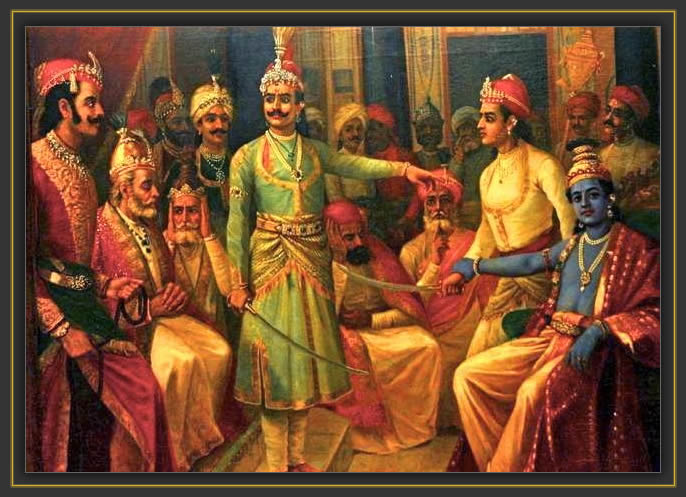
The first
picture is a detail from a 19th century painting, collection Karnataka
Chitra Kala Parishad.
The second painting is by the Indian painter and artist Raja Ravi
Varma.
Production: Filognostic
Association of The Order of Time.

Feed-back | Links | Downloads | Music | Pictures | What's New | Search | Donations



 Text 1