
Canto
11
Canto
11
Chapter 22: Prakriti and Purusha: Nature and the Enjoyer
(1-3) S'rî Uddhava said: 'Oh Lord of the Universe, how many basic elements of creation [tattvas] have been enumerated by the seers? Oh Master, I heard You speak about the twenty-eight basic elements of this world [see also 11.19: 14]. Some say there are twenty-six, others speak of twenty-five or twenty-seven, some speak of nine, some of four and others of eleven elements, while others speak of sixteen, seventeen or thirteen elements. Oh Eternal Supreme One, could You please explain to us what the sages, who so differently express themselves with the calculations of their divisions, have in mind with them?'
(4) The Supreme Lord said: 'With them [those elements] present everywhere, the brahmins speak the way it suits them, after all, what would there for those who lifted up [the veil of] My mâyâ, be difficult to say? (5) 'It is not the way you say it, it is the way I say it': this is what My unsurpassable [bewildering] energies do to those who argue about causes [see darshanas and 6.4: 31]. (6) Because My energies are interacting, differences of opinion arise among those who talk about this subject [of causation], but when one finds peace in the control over one's senses the controversy subsides and the arguing stops [one attains the true nature of the Supreme Spirit, âtmatattva]. (7) Because the various [subtle and gross] elements mutually pervade one another, oh best among men, a speaker wants to give a fitting description with an enumeration of causes and consequences. (8) With each of those divisions any single element refers to the other elements; whether it is there as a cause or an effect, when you see one element [like the ether] you also see all the other elements that element is part of [*]. (9) Discrimination as heard from the mouth of anyone who wants to reflect upon cause and effect, we accept [as authoritative], when that distinction originated from consistent reasoning. (10) A person is stuck to eternal ignorance and cannot all by himself figure out what the process of self-realization entails. That knowledge is derived from someone else familiar with the Absolute Truth [compare 11.21: 10]. (11) In this knowledge, belonging to the quality of goodnes of material nature, there is not the slightest difference between the purusha - the Supreme Being, the Soul, the actual person - and îs'vara the Lord. To suppose that it would be otherwise is a useless figment [see B.G. 18: 20 and 9: 15 and **]. (12) The basic qualities of goodness, passion and ignorance, as the causes of [respectively] maintenance, creation and destruction, constitute an equilibrium in material nature [prakriti] but [do] not [control] the soul [see also B.G. 3: 27]. (13) In this world the mode of goodness is of knowledge [light], the mode of passion is of fruitive labor [karma] and the mode of ignorance is of a lack of wisdom. The interaction of the modes is called Time and [the combination of] their natural disposition [svabhâva] constitutes the thread [or lead, symbolically worn by the first three varnas, see also 11.12: 19-21].
(14) The original person [purusha], the primary substance [prakriti, elementary nature], the visible manifestation [mahat-tattva, the 'great principle'], the identification with the form [ahankâra, false ego], ether, air, fire, water and earth are thus the nine elements of creation I referred to [in verse 1]. (15) Hearing, touching, seeing, smelling and tasting are the five [senses] by which one acquires knowledge; the speech organ, the hands, the genitals, the anus and the legs constitute their operation, oh dear one, and the mind is there for both of them. (16) Sounds, tactile qualities, tastes, fragrances, and forms [or colors] are the categories of the sense objects [see vishaya] and speech, manufacturing, excretion [by anus and genitals] and locomotion are the functions covered by them. (17) In the beginning of creation the purusha uninvolved witnesses the material nature of this universe, the universe that by the operation of sattva and the other modes assumes the forms of the gross manifestations and subtler causes [see also 2.10: 10]. (18) All the elements of the visible manifestation [the mahat-tattva] and what belongs to it, received their potencies from the glance of the Lord [the Original Person], undergo transformation and create, amalgamated by the power of nature, the egg of the universe [see also 2.5: 35, 3.20: 14-15, 3.26: 51-53, 3.32: 29, 5.26: 38, 11.6: 16]. (19) With the five physical elements beginning with the ether on the one hand and the individual knower [the jîva] with the Supreme Soul [the Paramâtma] on the other hand, we speak of seven constituent elements as the foundation from which the body, the senses and the life air [are produced]. (20) Departing from six elements one speaks of the Transcendental Person as the sixth element connected to the five material elements, the elements He first projected as His creation and thereupon entered. (21) When one speaks of four elements, fire, water and earth arise from the Original Self; from these elements this cosmos originated, the birth place of all material products. (22) Counting seventeen there is the consideration of the five gross elements, the five senses and their five objects together with the one mind and the soul as the seventeenth element. (23) The same way counting sixteen elements the soul is identified with the mind. With thirteen elements one has the five gross elements, the five senses, the mind and the [individual and supreme] soul. (24) Counting eleven elements one speaks of the soul, the gross elements and the senses. With the eight natural elements [the five gross ones, mind, intelligence and false ego] and the purusha, the Original Person, one thereupon has nine. (25) In this way the various divisions of the tattva elements have been contrived by the seers, all logically being supported by rational arguments; with the sages there is no lack of clarity.'
(26) S'rî Uddhava said: 'Because both nature and the enjoyer [prakriti and purusha], despite being constitutionally different, cover one another, oh Krishna, there seems to be no difference between the two: one sees the soul within nature and nature within the soul [see also B.G. 18: 16]. (27) Please, oh Lotus-eyed One, All-knowing and Very Expert in Reasoning, cut down with Your words the great doubt in my heart. (28) The living beings receive from You the knowledge that by the potency of Your outer illusion is stolen away [again]. Only You understand the real nature of Your illusory power and no one else [see also B.G. 15: 15].'
(29) The Supreme Lord said: 'Prakriti and purusha [nature and the enjoyer] are completely different, oh best of all persons. This creation [prakriti] is subjected to transformation because of the interaction of the gunas. (30) My dear, the deluding energy consisting of the three modes establishes by those basic qualities a diversity of combinations and mentalities. This changeable nature based upon the gunas is of three kinds, one is called adhyâtma, the next adhidaiva and another adhibhûta [see also kles'as and 1.17: 19]. (31) In this world one's sight [adhyâtma, as caused by oneself], that what one sees [adhibhûta, as caused by others] and the light upon it [adhidaiva, as caused by nature], create each other's perfection with the sun independently in the sky. [So too] the [Super]soul, the original cause separate from these three aspects, by its own conscious experience acts as the perfection of all that was achieved. (32) Next to the eyes the same [trinity] applies to the sense of touch and what one feels with it, to the ear and what one hears, to the tongue and its occupation, to the nose with what is smelled and to one's consciousness together with its attributes. (33) The agitation of the modes takes place on the basis of the primal ether and leads to changes [or pradhâna constitutes the cause of the time phenomena]. The principle of the intellect [the mahat-tattva, see also ***] therefrom gives rise to a false I-awareness that is the cause of three different types of bewilderment: emotion [vaikârika], ignorance [tâmasa] and sensual pleasure [aindriya]. (34) Lacking the full knowledge of the Supersoul one says things like 'this is real and that is not real' with the focus of discussion on material dualities. Although useless, such [speculations] will not cease for as long as persons have turned their attention away from Me, their true abode.'
(35-36) S'rî Uddhava said: 'How do those souls whose minds are diverted from You by the fruitful activities they perform, oh Master, accept and give up higher and lower material bodies? Please Govinda, explain to me what by those, who are not that spiritual, is not understood because they, predominantly with the knowledge of this world, were cheated.'
(37) The Supreme Lord said: 'The mind of the people ruled by their fruitive labor, is bound to the five senses. Traveling from one world to the next, the soul, which has a separate existence, follows that mind [see also linga, vâsanâ and B.G. 2: 22]. (38) The mind that depending its karma always contemplates, rises because of what is seen or heard through the senses, but inert [when dying away from the sense objects] the remembrance [of that life] is then lost. (39) This total forgetfulness of the living entity in which it does not remember a self that for this or that reason was absorbed in the objects of the senses, is what one calls death. (40) Oh man of charity, what one calls birth is when a person completely identifies himself with the body he assumed, just like what one does in a dream or when one has a fantasy. (41) And just as one in a dream or fantasy has no remembrance of a previous dream or fantasy, one neither thinks of having had a previous existence [*4 en B.G. 4: 5]. (42) Because of the creation of this sense refuge, this body, a threefold notion [of being of a high, middle or low class birth] appears concerning the form assumed. This leads the person to [believe in] an outer duality also found inside, like giving birth to bad offspring. (43) My best one, created bodies constantly find and lose their existence as a consequence of Time, the imperceptible stream not seen for being that subtle. (44) The lifespan, the circumstances and such of all created beings are determined by it, just like the flame of a candle, the stream of a river and the fruits of a tree are. (45) One has it wrong when one says 'this light is the same as this lamp' and 'this flow of water is the same as this river'. The same way it is wrong to say that 'this human [body] is the same as this person'. It is a way of reasoning by which men are wasting their lives [see also 6.16: 58, 7.6: 1-2]! (46) Actually this person does not take birth from the seed of his own activities, nor does he die. He is immortal and is only by illusion joined [with this body], just like fire with firewood [see B.G. 2: 24]. (47) Impregnation, gestation, birth, infancy, childhood, youth, middle age, old age and death are the nine stages of the body. (48) These superior or inferior physical conditions - that one owes to one's own motives [of karmic rebirth] -, a soul accepts as his own because of being bound to the modes, but sometimes he [by the grace of the Lord with due effort in yoga] manages to distance himself from them. (49) From the birth of one's offspring and death of one's forefathers one may conclude to the truth [of one's own life]. He who properly understands the characteristics of this duality [and thus knows he is the continuing soul] is no longer subject to this generation and destruction of things. (50) Someone knowing about the seed and maturity of a tree, is the witness distinct from the birth and death of that tree. One is the same way the witness separate from the [birth and death of] the physical body. (51) An unintelligent person who fails to distinguish between soul and matter and in touch with matter takes the external world for the real thing, lands completely bewildered in the cycle of birth and death [see also B.G. 9: 21-22 and 1.7: 5]. (52) Wandering around because of his karma he, when he follows the mode of goodness, will go to the sages and the gods. Following the lead of passion he will move among the common people or among the demons, and by the mode of ignorance he will find himself among the ghosts and spirits or reach the animal kingdom [see also B.G. 6: 41-42, 9: 25; 17: 4]. (53) Observing dancing and singing persons one tends to imitate them. The same way one is, despite [as a silent witness] not being engaged, inclined towards a material intelligence when one is faced with the qualities of matter [see also 11.21: 19-21]. (54-55) Just as trees seem to move when seen in water that moves and the world seems to spin when one's eyes are spinning around, one's mental impressions of experienced sense objects are neither real. Just like the things one sees in a dream are but figments of one's imagination, also the soul's image of a life of birth and death is but a phantom. (56) For someone meditating the objects of the senses, material life will not stop despite being an illusory affair, just like the occurrence of unpleasant things in a dream [may repeat itself *5]. (57) Therefore Uddhava, do not delight in the sense objects that play games with the senses. Just see how one, based upon the illusion of the material duality risen within the self, fails to realize the soul. (58-59) When one is insulted, neglected, ridiculed or envied by bad people, or else chastised, held captive or deprived of one's means of livelihood, or when one is repeatedly spat or urinated upon by ignorant people, someone desiring the Supreme who thus being shaken is having difficulties, should save himself by resorting to his essence [see also 5.5: 30].'
(60) S'rî Uddhava said: 'How do I learn this? Please, oh Best of All Speakers, tell us that. (61) The offenses of ignorant people against oneself, is what I find most difficult to tolerate. Even for scholars it is difficult, oh Soul of the Universe. Except for those who, fixed in Your dharma, in peace reside at Your lotus feet, material nature no doubt constitutes the greatest burden.'


Third revised edition, loaded July 2, 2022.
Previous Aadhar edition and Vedabase links:
S'rî Uddhava said: 'Oh Lord of the Universe, how many basic elements of creation [tattvas] have been enumerated by the seers? Oh Master, I heard You speak about the twenty-eight basic elements of this world [see also 11.19: 14]. Some say there are twenty-six, others speak of twenty-five or twenty-seven, some speak of nine, some of four and others of eleven elements, while others speak of sixteen, seventeen or thirteen elements. Oh Eternal Supreme One, could You please explain to us what the sages, who so differently express themselves with the calculations of their divisions, have in mind with them?'S'rî Uddhava said: 'O Lord of the Universe, how many basic elements of creation have been enumerated by the seers? O Master, I heard You speak about nine, eleven and five plus three basic elements [see also 11.19: 14]. Some say there are [not twenty-eight but] twenty-six, others speak of twenty-five or seven, some speak of nine, some of four and others of eleven, while some speak of sixteen, seventeen or thirteen. You should, o Eternal Supreme One, explain to us what the sages have in mind who so differently express themselves.' (Vedabase)
The Supreme Lord said: 'With them [those elements] present everywhere, the brahmins speak the way it suits them, after all, what would there for those who lifted up [the veil of] My mâyâ, be difficult to say?
The Supreme Lord said: 'With them [the elements] being everywhere speak the brahmins the way it suits them, after all, what would for those who concern themselves with [the mystical potency of] My mâyâ be the wrong thing to say? (Vedabase)
'It is not the way you say it, it is the way I say it': this is what My unsurpassable [bewildering] energies do to those who argue about causes [see darshanas and 6.4: 31].
'It is not the way you say it, it is the way I state it': this is what my unfathomable energies do to those who argue logically [see darshanas and 6.4: 31]. (Vedabase)
Because My energies are interacting, differences of opinion arise among those who talk about this subject [of causation], but when one finds peace in the control over one's senses, the controversy subsides and the arguing stops [one attains the true nature of the Supreme Spirit, âtmatattva].
Because My energies interact rise differences of opinion among the ones who talk about this subject, but when one finds peace in the control over one's senses subsides the controversy and stops the arguing [one reaches the true nature of the supreme spirit, âtmatattva]. (Vedabase)
Because the various [subtle and gross] elements mutually pervade one another, oh best among men, a speaker wants to give a fitting description with an enumeration of causes and consequences.
Because the various elements [subtle and gross] mutually pervade one another, o best among men, a speaker wants to provide a division of causes and consequences. (Vedabase)
With each of those divisions any single element refers to the other elements; whether it is there as a cause or an effect, when you see one element [like the ether] you also see all the other elements that element is part of [*].
With those divisions refers one element to the other elements: whether it is there as a cause or a consequence, in one element [viz. the ether] one finds all the other elements and vice versa [*]. (Vedabase)
Discrimination as heard from the mouth of anyone who wants to reflect upon cause and effect, we accept [as authoritative], when that distinction originated from consistent reasoning.
When people departing from a certain division for that reason express themselves in terms of cause and effect, I accept that which is voiced with such a point of view on the condition that it is guided by reason [by scientific proof, by specificity about time and place]. (Vedabase)
A person is stuck to eternal ignorance and cannot all by himself figure out what the process of self-realization entails. That knowledge is derived from someone else familiar with the Absolute Truth [compare 11.21: 10].
A person who inevitably is born in ignorance cannot all by himself figure out what the process of selfrealization all means, that knowledge is derived from someone else who is known with the principle of reality [compare 11.21: 10]. (Vedabase)
In this knowledge, belonging to the quality of goodness of material nature, there is not the slightest difference between the purusha - the Supreme Being, the Soul, the actual person - and îs'vara the Lord. To suppose that it would be otherwise is a useless figment [see B.G. 18: 20 and 9: 15 and **].
There is according to this knowledge in the material mode of goodness not the slightest difference between the purusha, the original person, and îs'vara, the controller. To suppose that there would be such a difference is a useless endeavor [see B.G. 18: 20 and 9: 15 and **]. (Vedabase)
The basic qualities of goodness, passion and ignorance, as the causes of [respectively] maintenance, creation and destruction, constitute an equilibrium in material nature [prakriti] but [do] not [control] the soul [see also B.G. 3: 27].
Material nature [prakriti] is what binds the modes. These modes as the causes of keeping, producing and ending that accordingly are said to be of goodness, passion and ignorance, belong to the material world and not to the spirit soul [see also B.G. 3: 27]. (Vedabase)
In this world the mode of goodness is of knowledge [light], the mode of passion is of fruitive labor [karma] and the mode of ignorance is of a lack of wisdom. The interaction of the modes is called Time and [the combination of] their natural disposition [svabhâva], constitutes the thread [or lead, symbolically worn by the first three varnas, see also 11.12: 19-21].
In this world is the mode of goodness of knowledge, the mode of passion of fruitive labor [karma] and the mode of darkness of ignorance; the interaction of the modes is called Time and that what's there by nature constitutes the thread [the mahat-tattva is the sûtra, see also 11.12: 19-21]. (Vedabase)
The original person [purusha], the primary substance [prakriti, elementary nature], the visible manifestation [mahat-tattva, the 'great principle'], the identification with the form [ahankâra, false ego], ether, air, fire, water and earth are thus the nine elements of creation I referred to [in verse 1].
The soul enjoying [purusha], material nature [prakriti], the intelligible [mahat-tattva], the identification with the form [ahankâra], ether, air, fire, water and earth are thus My nine elements of creation referred to [in verse 1]. (Vedabase)
Hearing, touching, seeing, smelling and tasting are the five [senses] by which one acquires knowledge; the speech organ, the hands, the genitals, the anus and the legs constitute their operation, oh dear one, and the mind is there for both of them.
Hearing, touching, seeing, smelling and tasting are the five [senses] by which one acquires knowledge; the speech organ, the hands, the genitals, the anus and the legs constitute their operation, o dear one, and the mind is there for both. (Vedabase)
Sounds, tactile qualities, tastes, fragrances, and forms [or colors] are the categories of the sense objects [see vishaya] and speech, manufacturing, excretion [by anus and genitals] and locomotion are the functions covered by them.
Sounds, tactile qualities, tastes, fragrances, and forms [or colors] are the categories of the sense objects [see vishaya] and speech, manufacturing, excretion [by anus and genitals] and locomotion are the functions covered by them. (Vedabase)
In the beginning of creation the purusha uninvolved witnesses the material nature of this universe, the universe that by the operation of sattva and the other modes assumes the forms of the gross manifestations and subtler causes [see also 2.10: 10].
In the beginning of creation is the person of the enjoyer uninvolved given to witnessing the material nature of this universe, the universe that by the operation of sattva and the other modes assumes the forms of the gross manifestations and subtler causes [see also 2.10: 10]. (Vedabase)
All the elements of the visible manifestation [the mahat-tattva] and what belongs to it, received their potencies from the glance of the Lord [the Original Person], undergo transformation and create, amalgamated by the power of nature, the egg of the universe [see also 2.5: 35, 3.20: 14-15, 3.26: 51-53, 3.32: 29, 5.26: 38, 11.6: 16].
All the elements that received their potencies from the glance of the Lord, in the manifest reality undergo transformation and form, amalgamated by the power of nature, the egg of the universe [see also 2.5: 35, 3.20: 14-15, 3.26: 51-53, 3.32: 29, 5.26: 38, 11.6: 16]. (Vedabase)
With the five physical elements beginning with the ether on the one hand and the individual knower [the jîva] with the Supreme Soul [the Paramâtma] on the other hand, we speak of seven constituent elements as the foundation from which the body, the senses and the life air [are produced].
When one speaks about the creation as having only seven elements: the five of the physical elements beginning with the ether on the one hand and the individual knower with the Supreme Soul on the other hand, there are as a consequence of this fundamental, dual basis the body, the senses and the life air. (Vedabase)
Departing from six elements one speaks of the Transcendental Person as the sixth element connected to the five material elements, the elements He first projected as His creation and thereupon entered.
And when one departs from six elements: the five elements with the Transcendental Person as the sixth element that is conjoined with them, He has first projected this creation and next entered it. (Vedabase)
When one speaks of four elements, fire, water and earth arise from the Original Self; from these elements this cosmos originated, the birth place of all material products.
When one speaks of four elements fire, water and earth arise from the Original Self; from these elements there is then the manifest product of this cosmos. (Vedabase)
Counting seventeen there is the consideration of the five gross elements, the five senses and their five objects together with the one mind and the soul as the seventeenth element.
Counting seventeen there is the consideration of the five gross elements, the five objects and the five senses along with the one mind and the soul as the seventeenth. (Vedabase)
The same way counting sixteen elements the soul is identified with the mind. With thirteen elements one has the five gross elements, the five senses, the mind and the [individual and supreme] soul.
So too one is counting with sixteen elements when one identifies the soul with the mind. With thirteen elements one has the five gross elements, the five senses, the mind and the [individual and supreme of the] soul. (Vedabase)
Counting eleven elements one speaks of the soul, the gross elements and the senses. With the eight natural elements [the five gross ones, mind, intelligence and false ego] and the purusha, the Original Person, one thereupon has nine.
Counting eleven elements in this one has the soul, the gross elements and the senses. One also knows nine of them with the eight natural elements [the five gross ones, mind, intelligence and false ego] and the Enjoyer in the beyond. (Vedabase)
In this way the various divisions of the tattva elements have been contrived by the seers, all logically being supported by rational arguments; with the sages there is no lack of clarity.'
Thus have various enumerations of the elements been contrived by the sages. They are all logically supported by rational arguments, that is the brilliance one finds with the learned.' (Vedabase)
S'rî Uddhava said: 'Because both nature and the enjoyer [prakriti and purusha], despite being constitutionally different, cover one another, oh Krishna, there seems to be no difference between the two: one sees the soul within nature and nature within the soul [see also B.G. 18: 16].
S'rî Uddhava said: 'Because both nature and the enjoyer, even though they are constitutionally different, cover one another o Krishna, there seems to be no difference between them: one sees the soul within nature and nature within the soul [see also B.G. 18: 16]. (Vedabase)
Please, oh Lotus-eyed One, All-knowing and Very Expert in Reasoning, cut down with Your words the great doubt in my heart.
Please, o Lotus eyed One, as the Omniscient, Very Expert in Reasoning, cut with Your words down the great doubt in my heart. (Vedabase)
The living beings receive from You the knowledge that by the potency of Your outer illusion is stolen away [again]. Only You understand the real nature of Your illusory power and no one else [see also B.G. 15: 15].'
The living beings have from You indeed the knowledge and by the potency of Your outer illusion it is stolen away. Only You understand the ins and outs of Your ilusory power and no one else [see also B.G. 15: 15].' (Vedabase)
The Supreme Lord said: 'Prakriti and purusha [nature and the enjoyer] are completely different, oh best of all persons. This creation [prakriti] is subjected to transformation because of the interaction of the gunas.
The Supreme Lord said: 'Prakriti and purusha [nature and the enjoyer] are two distinct matters, o best of all persons, and both are subjected to the transformation that is based upon the mixing of the gunas of creation. (Vedabase)
My dear, the deluding energy consisting of the three modes establishes by those basic qualities a diversity of combinations and mentalities. This changeable nature based upon the gunas is of three kinds, one is called adhyâtma, the next adhidaiva and another adhibhûta [see also kles'as and 1.17: 19].
Dear Uddhava, My deluding energy consisting of the three modes is responsible for the diversity of manifestations as well as for the variety of different forms of perception. This changeable nature based upon the gunas knows three aspects: one is called adhyâtma, then there is adhidaiva and the other is called adhibhûta [see also kles'as and 1.17: 19]. (Vedabase)
In this world one's sight [adhyâtma, as caused by oneself], that what one sees [adhibhûta, as caused by others] and the light upon it [adhidaiva, as caused by nature], create each other's perfection with the sun independently in the sky. [So too] the [Super]soul, the original cause separate from these three aspects, by its own conscious experience acts as the perfection of all that was achieved.
Alike the independently of these existing Supersoul who constitutes the actual cause of the subjective experience [adhyâtma], nature as the source of one's perception [adhidaiva] and the phenomenon one perceives [adhibhûta], is there similarly the sun in its independent position in the sky, that is responsible for the power of sight [adhyâtma], the external of nature [adhidaiva] and the distinct, reflected image [adhibhûta] that together contribute to that what can be seen through the opening of the eye. (Vedabase)
Next to the eyes the same [trinity] applies to the sense of touch and what one feels with it, to the ear and what one hears, to the tongue and its occupation, to the nose with what is smelled and to one's consciousness together with its attributes.
Next to the eyes the same [trinity] applies to the sense of touch and what one feels with it, the ear and what one hears, the tongue and its occupation, the nose with what is smelled and with one's consciousness and its attributes. (Vedabase)
The agitation of the modes takes place on the basis of the primal ether and leads to changes [or pradhâna constitutes the cause of the time phenomena]. The principle of the intellect [the mahat-tattva, see also ***] therefrom gives rise to a false I-awareness that is the cause of three different types of bewilderment: emotion [vaikârika], ignorance [tâmasa] and sensual pleasure [aindriya].
The transformation effected by this agitation of the modes which rooted from the primary nature [pradhâna], leads to bewilderment and gives all kinds of trouble with the by the greater reality [the mahat-tattva] raised threefold, false ego which, subjected to change, in ignorance wants to take matters into its own hands [see also ***]. (Vedabase)
Lacking the full knowledge of the Supersoul one says things like 'this is real and that is not real' with the focus of discussion on material dualities. Although useless, such [speculations] will not cease for as long as persons have turned their attention away from Me, their true abode.'
When there is not the full knowledge of the Supersoul one will, eager as one is in one's desire to discuss matters, get entangled in useless speculations about the fact whether or not there would be a difference [between purusha and prakriti] with statements like 'this is real and that is not', and those speculations continue as long as one has diverted one's attention away from Me, I who am [qualitatively] equal to oneself.' (Vedabase)
S'rî Uddhava said: 'How do those souls whose minds are diverted from You by the fruitful activities they perform, oh Master, accept and give up higher and lower material bodies? Please Govinda, explain to me what by those, who are not that spiritual, is not understood because they, predominantly with the knowledge of this world, were cheated.'
S'rî Uddhava said: 'In what way do those whose minds diverted from You by the fruitive activities they performed, o Master, accept and give up higher and lower material bodies? Please Govinda explain that to me what by those who are not so spiritual isn't understood since they, predominantly being of material knowledge, are illusioned.' (Vedabase)
The Supreme Lord said: 'The mind of the people ruled by their fruitive labor, is bound to the five senses. Traveling from one world to the next, the soul, which has a separate existence, follows that mind [see also linga, vâsanâ and B.G. 2: 22].
The Supreme Lord said: 'People's minds that are shaped by their fruitive labor are bound to the five senses from one world to the next. The soul, existing separately, follows that mind [see also linga, vâsanâ and B.G. 2: 22]. (Vedabase)
The mind that depending its karma always contemplates, rises because of what is seen or heard through the senses, but inert [when dying away from the sense objects] the remembrance [of that life] is then lost.
The mind faithfully meditating on what is heard [from the traditions] or what is seen of the sense objects comes into being because of its being bound to the karma and dissolves again [with the vanishing of the sense objects]. As a consequence the remembrance [of past lives] is lost. (Vedabase)
This total forgetfulness of the living entity in which it does not remember a self that for this or that reason was absorbed in the objects of the senses, is what one calls death.
This total forgetfulness of not remembering one's previous self that for this or that reason was absorbed in the objects of the senses, is what one calls death. (Vedabase)
Oh man of charity, what one calls birth is when a person completely identifies himself with the body he assumed, just like what one does in a dream or when one has a fantasy.
O man of charity, what one calls birth is when a person completely identifies himself with the body he assumed, just like what one does when one dreams or when one has a fantasy. (Vedabase)
And just as one in a dream or fantasy has no remembrance of a previous dream or fantasy, one neither thinks of having had a previous existence [*4 en B.G. 4: 5].
And just as one in a dream or fantasy has no remembrance of a previous dream or fantasy, one has likewise no notion of a previous existence [*4 en B.G. 4: 5]. (Vedabase)
Because of the creation of this sense refuge, this body, a threefold notion [of being of a high, middle or low class birth] appears concerning the form assumed. This leads the person to [believe in] an outer duality also found inside, like giving birth to bad offspring.
Because of obtaining a new material body and a corresponding mind, the truth of the threefold reality imposes itself upon the soul, with the consequence of an inner notion that differs from the outer appearance, like one gave birth to bad natured offspring. (Vedabase)
My best one, created bodies constantly find and lose their existence as a consequence of Time, the imperceptible stream not seen for being that subtle.
For created bodies, My best, find and lose their existence by the force of time which operates invisibly, that isn't seen because of its subtlety. (Vedabase)
The lifespan, the circumstances and such of all created beings are determined by it, just like the flame of a candle, the stream of a river and the fruits of a tree are.
The lifespan, the circumstances and such of all created beings are determined by it, just as the flame of a candle, the stream of a river and the fruit of a tree are determined by it. (Vedabase)
One has it wrong when one says 'this light is the same as this lamp' and 'this flow of water is the same as this river'. The same way it is wrong to say that 'this human [body] is the same as this person'. It is a way of reasoning by which men are wasting their lives [see also 6.16: 58, 7.6: 1-2]!
The way one has it wrong when one says 'this light is the same as this lamp' and 'this stream of water is the same as this river' it is also wrong to say that 'this body is the same as this person', it is a way of reasoning of men who are wasting their lives [see also 6.16: 58, 7.6: 1-2]! (Vedabase)
Actually this person does not take birth from the seed of his own activities, nor does he die. He is immortal and is only by illusion joined [with this body], just like fire with firewood [see B.G. 2: 24].
A person doesn't die, nor is he born from the seed of his actions, he is immortal. It is because of illusion that one, like fire locked up in wood, is united [with one's material existence. See B.G. 2: 24]. (Vedabase)
Impregnation, gestation, birth, infancy, childhood, youth, middle age, old age and death are the nine stages of the body.
Impregnation, gestation, birth, infancy, childhood, youth, middle age, old age and death are the nine states of the body one thus has. (Vedabase)
These superior or inferior physical conditions - that one owes to one's own motives [of karmic rebirth] -, a soul accepts as his own because of being bound to the modes, but sometimes he [by the grace of the Lord with due effort in yoga] manages to distance himself from them.
These more or less elevated states of the body that one owes to one's own motives, are because of his being bound to the modes by a soul accepted as one's own, while the other soul [with due effort in yoga] distances himself from them [by the grace of God]. (Vedabase)
From the birth of one's offspring and death of one's forefathers one may conclude to the truth [of one's own life]. He who properly understands the characteristics of this duality [and thus knows he is the continuing soul] is no longer subject to this generation and destruction of things.
The incidence of one's own birth can be inferred from the birth of one's son and the incidence of one's death can be derived from the death of one's father [or ancestors], [but] he who remembers himself with all the things of birth and death is never subject to that what is ruled by this duality. (Vedabase)
Someone knowing about the seed and maturity of a tree, is the witness distinct from the birth and death of that tree. One is the same way the witness separate from the [birth and death of] the physical body.
The way someone, who knows about a tree its seed and maturity, is the witness distinct from the birth and death of that tree, is one analogously the witness standing apart from the [birth and death of] the physical body. (Vedabase)
An unintelligent person who fails to distinguish between soul and matter and in touch with matter takes the external world for the real thing, lands completely bewildered in the cycle of birth and death [see also B.G. 9: 21-22 and 1.7: 5].
An unintelligent person who fails to distinguish this way the person from his material nature, enters, completely bewildered in taking material forms for real, the material ocean [see also B.G. 9: 21-22 and 1.7: 5]. (Vedabase)
Wandering around because of his karma he, when he follows the mode of goodness, will go to the sages and the gods. Following the lead of passion he will move among the common people or among the demons, and by the mode of ignorance he will find himself among the ghosts and spirits or reach the animal kingdom [see also B.G. 6: 41-42, 9: 25; 17: 4].
Wandering around because of his karma he will, following the mode of goodness, head for the sages and the gods; following the lead of passion he will move among the common people or fall into the grip of darkness; and by the mode of ignorance he will find himself among the ghosts and spirits or reach the animal kingdom [see also B.G. 6: 41-42, 9: 25; 17: 4]. (Vedabase)
Observing dancing and singing persons one tends to imitate them. The same way one is, despite [as a silent witness] not being engaged, inclined towards a material intelligence when one is faced with the qualities of matter [see also 11.21: 19-21].
Just as with observing dancing and singing persons one comes to imitate them, one is, even though being a silent witness who doesn't do anything, when one is placed before the qualities of matter the same way inclined towards a material intelligence [see also 11.21: 19-21]. (Vedabase)
Just as trees seem to move seen in water that moves and the world seems to spin when one's eyes are spinning around, one's mental impressions of experienced sense objects are neither real. Just like the things one sees in a dream are but figments of one's imagination, also the soul's image of a life of birth and death is but a phantom.
The way trees seem to be moving when they are seen in moving water and the world seems to spin when one's eyes are spinning around, one's mental impressions of the sense object are also not real. Just like the things one sees in a dream are but figments, also the soul's image of a material life in which he experiences sense gratification is a phantom. (Vedabase)
For someone meditating the objects of the senses, material life will not stop despite being an illusory affair, just like the occurrence of unpleasant things in a dream [may repeat itself *5].
For someone who meditates the objects of the senses material life will not stop, even though it is an illusory affair, just as the unpleasant things one experiences in a dream [may repeat themselves over and over *5]. (Vedabase)
Therefore Uddhava, do not delight in the sense objects that play games with the senses. Just see how one, based upon the illusion of the material duality risen within the self, fails to realize the soul.
Therefore Uddhava, do not delight in the sense-objects that play games with the senses, just see how based upon the illusion of the material duality one fails to realize the soul. (Vedabase)
When one is insulted, neglected, ridiculed or envied by bad people, or else chastised, held captive or deprived of one's means of livelihood, or when one is repeatedly spat or urinated upon by ignorant people, someone desiring the Supreme who thus being shaken is having difficulties, should save himself by resorting to his essence [see also 5.5: 30].'
When one is insulted, neglected, ridiculed or envied by bad people, or else chastised, held captive or deprived of his means of livelihood, or when one is repeatedly spat or urinated upon by ignorant people, someone desiring the Supreme who thus being shaken is having difficulties, should save himself by resorting to his essence [see also 5.5: 30].' (Vedabase)
S'rî Uddhava said: 'How do I learn this? Please, oh Best of All Speakers, tell us that.
S'rî Uddhava said: 'How can I keep that in mind? Please, o Best of All Speakers, tell us that. (Vedabase)
The offenses of ignorant people against oneself, is what I find most difficult to tolerate. Even for scholars it is difficult, oh Soul of the Universe. Except for those who, fixed in Your dharma, in peace reside at Your lotus feet, material nature no doubt constitutes the greatest burden.'
The attacks of other people on my person is what I find most difficult. Except to those who fixed in Your dharma in peace reside at Your lotus feet, even for the learned, o Soul of the Universe, no doubt the material definition constitutes the greatest burden.' (Vedabase)
*: Two examples: A pot is part of the element earth and earth is part of a pot. All matter is part of the ether [substantial space] and ether is part of all the elements.
**: The paramparâ adds here: 'S'rî Caitanya Mahâprabhu described the actual situation as acintya-bhedâbheda-tattva - the supreme controller and the controlled living entities are simultaneously one and different. In the material mode of goodness the oneness is perceived. As one proceeds further, to the stage of vis'uddha-sattva, or purified spiritual goodness, one finds spiritual variety within the qualitative oneness, completing one's knowledge of the Absolute Truth' [see also siddhânta].
***: To differentiate the basic terms used in this chapter: Prakriti is the material nature with its living beings and gunas, pradhâna is the primordial, undifferentiated state of matter without the specific creatures and gunas and the mahat-tattva is the totality of the greater reality of it all, also known as the principle of intellect or the cosmic intelligence. The purusha is the original person who is the enjoyer: the Lord and the living beings who are the same in quality.
*4: According to the well-known exception that confirms the rule says S'rîla Vis'vanâtha Cakravartî Thhâkura here that by the mystic power of jâti-smara one may remember one's previous body. Patañjali in the Yoga Sutra III.18 says: 'Impressions which, carried along in the self, surface, give insight in previous states of life'.
*5: The classical philosophical stance defended here is: 'When one has a body one is a soul, when one is a body one is a pig', where the pig is here the fallen soul returning time and again to a materialistic life.

The
text and audio are offered under the conditions of the
Creative
Commons
Attribution-Noncommercial-Share
Alike 3.0 Unported License.
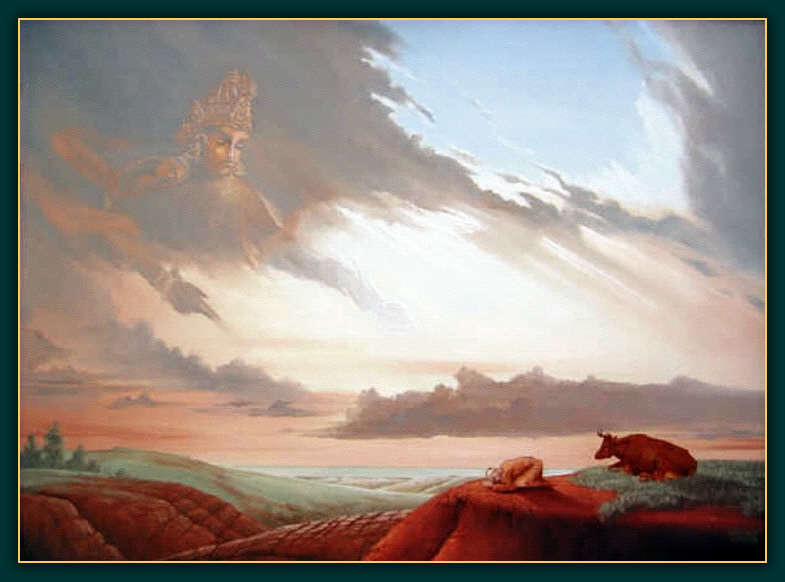
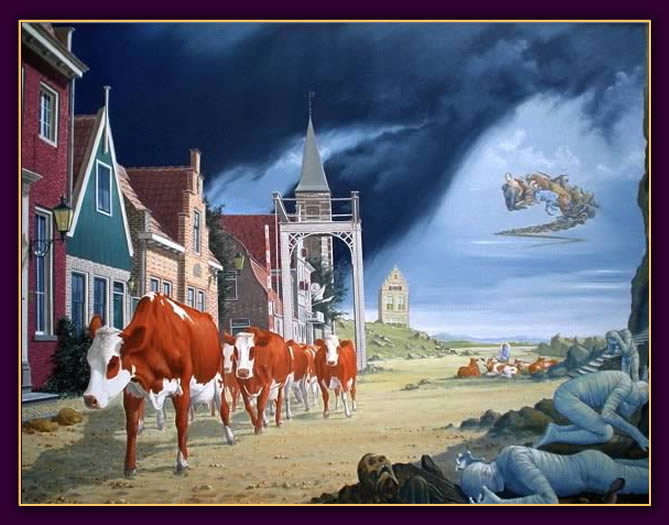
The first
painting is titled 'Devotee' and the second one is titled
"Wrestling with matter".
© Wim Kuenen, used with permission.
Production: Filognostic Association of The Order of Time

Feed-back | Links | Downloads | Music | Pictures | What's New | Search | Donations



 Text 1-3