
Canto
5
Chapter 22: The movement of the Planets and their Considered Effects
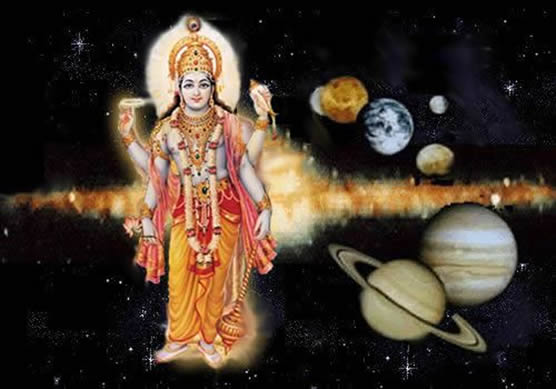
(1) The king said: 'Your lordship described how the most powerful god of the sun moves around Mount Meru and Dhruvaloka leaving them to his right side, ànd that he, with the different signs of the zodiac right in front of him, leaves them to his left. What should we think about that?'
(2) To that he [S'uka] clearly stated: 'Just as what one sees with the movements of small ants spinning around on a potter's wheel, that because of their changing positions experience a different orientation, such a difference can also be observed with the movement [of the sun and the planets] in relation to Meru and Dhruvaloka [the central heap of stars and the galaxy center]. With the stars moving around [that center], the two are located at their right side, but because of the individual movements of the planets led by the sun upon that rotating wheel of time, the sun and planets that are observed in different mansions and constellations are evidently of another progress.
(3) He [that solar lead of time], this supremely powerful Original Person who is Nârâyana Himself, the Supersoul of the three Vedic principles who is there for the benefit and karmic purification of all the worlds, is the cause sought by all saintly and Vedic knowing. He divides the year, as He thinks fit, in its twelve parts and arranges the six seasons beginning with spring with their different qualities. (4) The people here, who in respect of the threefold of Vedic knowledge follow the higher or more earthly standards of the status orientations [of varna and âs'rama], attain without difficulty the ultimate benefit of life when they worship Him full of faith with ritual activities and grow in the science of uniting their consciousness [in yoga]. (5) He now, the Soul of all the worlds, who [in the form of the sun] has entered the wheel of time in a position between heaven and earth, passes through the twelve divisions of the year consisting of the months that are named after the signs of the zodiac. The scholars teach that they [according to the moon] are divided in bright and dark halves or [fifteen day] fortnights and that, following their instruction, the six portions of its orbit, called ritu or season, calculated to the stars, each cover two and a quarter constellations [thus one speaks of twelve or more constellations]. (6) They also say that the period of time the sun moves through [the visible] half of outer space is called an ayana. (7) The time that the passage of the sun takes moving through both the spheres above and below, speeding slow, fast or moderate, is in the descriptions of the scholars, discussed as a samvatsara [a solar year], a parivatsara [one twelfth of a revolution of Jupiter], an idâvatsara [a day of the gods consisting of 360 solar days] an anuvatsara [a lunar year comprising twelve lunations] and a vatsara [a year to the ecliptic in terms of the 27 lunar mansions or nakshatras, see also 3.11: 14].
(8) By the sunlit moon that is situated a hundred thousand yojanas [astronomy: ± 385.000 km] above [the earth] and is moving much faster [than the sun], in the course of a month [two 'fifteen day periods'] a distance is covered that takes the sun a whole year, is in two and a quarter day a distance described that takes the sun a month and is in one day a part of the sky traversed that by the sun is covered in fourteen days. (9) The moon, changing its phases, waxes to the [full] part of the moon that is of the demigods and wanes to the [dark] part of the moon that is of the forefathers. In [about] thirty muhûrtas [a full day] every time passing one of the lunar mansions [or nakshatras], it with its waxing and waning constitutes the division of the days [of the gods] and the nights [of the forefathers] of all the different living entities. Thus it is considered the jîva or essence of their life. (10) This moon with all its sixteen parts [shodas'akala] is by the scholars described as the Supreme Person, the predominating deity of the mind, the power source of all food, who represents all delight in life. He is considered the refreshing, all-pervading life breath [prâna] of all the demigods, ancestors, human beings and all other living entities like the mammals, the birds, the reptiles and the plants.
(11) [More than] two hundred thousand yojanas behind [the moon], there are [spinning] with Meru to the right, to the many stars that by the Supreme Controller were attached to the wheel of time, the twenty-eight lunar mansions including Abhijit.
(12) At a distance of two hundred thousand yojanas there about [about the star center or the sun; astronomy: at a distance of 107 million km] there is Us'anâ [Venus], the planet that can be seen going in front of, going behind and rotating along with the sun just as fast, slow or with a moderate speed. It is of all the planets the one considered to exert as good as always a favorable influence in the form of rainfall; it by its movements neutralizes the influence of planets that obstruct rainfall.
(13) Another two hundred thousand yojanas behind Venus [astronomy: 57.9 million km from the sun], so is explained, Budha [Mercury] is situated, the son of the moon. It is as good as always working auspiciously, but during the time it is not moving along with the sun, there is almost always an increase of fearful conditions like draughts, a closed sky and stormy conditions.
(14) At two hundred thousand yojanas outside of our orbit one also finds Angâraka [Mars, astronomy: at about 228 million km from the sun]. If it does not make a [retrogade] curve, it passes by three fortnights each, one after another the twelve signs of the zodiac. It is as good as always an unfavorable planet causing trouble.
(15) Two hundred thousand yojanas outside of Mars [astronomy: 778.3 million km from the sun] one finds the most powerful planet of Brihaspati [Jupiter] that, if it does not run a curve, takes a year [a parivatsara] to move through a single constellation. It almost always turns out to work in favor of the family of the brahmins.
(16) Two hundred thousand yojanas behind it is situated S'anais'cara [Saturn, astronomy: 1.43 billion km from the sun], that takes a period of thirty months to travel through a single sign of the zodiac. Being that slow it takes an equal number of years [30 anuvatsaras] to cover all of them. It means almost always a lot of trouble to all.
(17) At 1.1 million yojanas beyond that planet are situated the [seven] great sages [represented by the seven stars of the Great Bear, Ursa Major] who always consider the good fortune of the inhabitants of all the worlds. They clockwise circumambulate the transcendental abode of the Supreme Lord Vishnu [the center of the stars].'


Third revised edition, loaded July 2, 2018.

Previous Aadhar edition and Vedabase links:
The king said: 'Your lordship described how the most powerful god of the sun moves around Mount Meru and Dhruvaloka leaving them to his right side, ànd that he, with the different signs of the zodiac right in front of him, leaves them to his left. What should we think about that?'
The king said: 'Your lordship described how the most powerful god of the sun leaves Mount Meru and Dhruvaloka to its right moving through the different signs and as well going around facing them forwards leaves them at his left side; how must we according reason accept that? (Vedabase)
To that he [S'uka] clearly stated: 'Just as what one sees with the movements of small ants spinning around on a potter's wheel, that because of their changing positions experience a different orientation, such a difference can also be observed with the movement [of the sun and the planets] in relation to Meru and Dhruvaloka [the central heap of stars and the galaxy center]. With the stars moving around [that center], the two are located at their right side, but because of the individual movements of the planets led by the sun upon that rotating wheel of time, the sun and planets that are observed in different mansions and constellations are evidently of another progress.
To that he [S'uka] clearly stated: 'Just like one, with the movements of small ants spinning around on a potters wheel, may be sure that, due to their changing locations, there is a different experience, may one also be sure of such a difference in moving relative to Meru and Dhruvaloka [the central heap of stars and the galaxy center]: with the stars, that go around with the great wheel of time, they are located at the right, but of the individual motions by the planets lead by the sun upon that spinning wheel of time, is the movement to the stars and signs for sure observed differently. (Vedabase)
He [that solar lead of time], this supremely powerful Original Person who is Nârâyana Himself, the Supersoul of the three Vedic principles who is there for the benefit and karmic purification of all the worlds, is the cause sought by all saintly and Vedic knowing. He divides the year, as He thinks fit, in its twelve parts and arranges the six seasons beginning with spring with their different qualities.
That cause, this supremely powerful original person directly seen as Nârâyana the Supersoul of the three Vedas, who is there for the benefit and karmic purification of all the worlds, is the cause after which all the saintly and vedic knowing inquires; He arranges for the twelve divisions of the year as well as, according to what was enjoyed before, for the different qualities to the sixfold of the seasons beginning with spring. (Vedabase)
The people here, who in respect of the threefold of Vedic knowledge follow the higher or more earthly standards of the status orientations [of varna and âs'rama], attain without difficulty the ultimate benefit of life when they worship Him full of faith with ritual activities and grow in the science of uniting their consciousness [in yoga].
All people down here who, of the threefold of vedic knowledge and the higher or more earthly doings of the statusoriëntations, follow this of Him, attain without difficulty the ultimate benefit of life, as they according their karma worship and to their faith grow in yoga. (Vedabase)
He now, the Soul of all the worlds, who [in the form of the sun] has entered the wheel of time in a position between heaven and earth, passes through the twelve divisions of the year consisting of the months that are named after the signs of the zodiac. The scholars teach that they [according to the moon] are divided in bright and dark halves or [fifteen day] fortnights and that, following their instruction, the six portions of its orbit, called ritu or season, calculated to the stars, each cover two and a quarter constellations [thus one speaks of twelve or more constellations].
Therefore is He this living force of all the three worlds that between the upper and lower of the universe are positioned in outer space on the wheel of time; in twelve months passing through signs that accordingly divide the solar year, is there a month with two fortnights, that are like the day and night, and indeed that portion of the year that is remembered as a season covering one sixth of the orbit or two and a quarter constellation by stellar calculation [thus one speaks of twelve or more constellations, see also 3.21: 18]. (Vedabase)
They also say that the period of time the sun moves through [the visible] half of outer space is called an ayana.
So too is the period of time the sun moves through half of the outer space called an ayana. (Vedabase)
The time that the passage of the sun takes moving through both the spheres above and below, speeding slow, fast or moderate, is in the descriptions of the scholars discussed as a samvatsara [a solar year], a parivatsara [one twelfth of a revolution of Jupiter], an idâvatsara [a day of the gods consisting of 360 solar days] an anuvatsara [a lunar year comprising twelve lunations] and a vatsara [a year to the ecliptic in terms of the 27 lunar mansions or nakshatras, see also 3.11: 14].
Now also for the time that it takes the sun, thus speeding slow, fast or moderate, to move entirely through the spheres above and below, is indeed with its passage, to the descriptions of the scholars, spoken of a samvatsara [tropical year], a parivatsara [full year], an idâvatsara [the current year] an anuvatsara [a repeated year] and a vatsara [single year]. (Vedabase)
By the sunlit moon that is situated a hundred thousand yojanas [astronomy: ± 385.000 km] above [the earth] and is moving much faster [than the sun], in the course of a month [two 'fifteen day periods'] a distance is covered that takes the sun a whole year, is in two and a quarter day a distance described that takes the sun a month and is in one day a part of the sky traversed that by the sun is covered in fourteen days.
By the sunlit moon, that is situated a hundred thousand yojanas [astronomy: ± 385.000 km] above [the earth] and is moving much faster [than the sun], is so the passage of one year of the sun covered by the passage of two fortnights, is in two and a quarter of a day one solar month [or one twelfth of the sky] passed and is in only one day [the portion of] a fortnight of solar days passed. (Vedabase)
The moon, changing its phases, waxes to the [full] part of the moon that is of the demigods and wanes to the [dark] part of the moon that is of the forefathers. In [about] thirty muhûrtas [a full day] every time passing one of the lunar mansions [or nakshatras], it with its waxing and waning constitutes the division of the days [of the gods] and the nights [of the forefathers] of all the different living entities. Thus it is considered the jîva or essence of their life.
So too does the moon, in changing its phases, wax to the part of the moon that is of the demigods and does it wane to the part of the moon that is of the forefathers. Thus it distributes the days and nights of the sum total of all living entities and is it considered the Jîva or essence of their life by one after another in [about] thirty muhûrtas [a full day] passing through a constellation. (Vedabase)
This moon with all its sixteen parts [shodas'akala] is by the scholars described as the Supreme Person, the predominating deity of the mind, the power source of all food, who represents all delight in life. He is considered the refreshing, all-pervading life breath [prâna] of all the demigods, ancestors, human beings and all other living entities like the mammals, the birds, the reptiles and the plants.
This moon in all its aspects is by the scholars described as the Supreme Person, the predominating deity of the mind, the source of potency for all food and all delight of living and certainly the refreshing, all-pervading life-air of all the gods, the ancestors, all human beings and all living entities like the mammals, the birds, the reptiles and the plants. (Vedabase)
[More than] two hundred thousand yojanas behind [the moon], there are [spinning] with Meru to the right, to the many stars that by the Supreme Controller were attached to the wheel of time, the twenty-eight lunar mansions including Abhijit.
[More than] two hundred thousand yojanas behind [the moon], leaving Meru to the right are there, together with the many stars that by the Controller were attached to the wheel of time, the twenty-eight stars headed by Abhijit. (Vedabase)
At a distance of two hundred thousand yojanas there about [about the star center or the sun; astronomy: at a distance of 107 million km] there is Us'anâ [Venus], the planet that can be seen going in front of, going behind and rotating along with the sun just as fast, slow or with a moderate speed. It is of all the planets the one considered to exert as good as always a favorable influence in the form of rainfall; it by its movements neutralizes the influence of planets that obstruct rainfall.
Two hundred thousand yojanas there about [about the star center or the sun, astronomy: at a distance of 107 million km ] is there Venus, experienced as indeed going in front, behind and going along with the sun, in its movements just like the sun rotating fast, slow or with a moderate speed. Of all the planets is it seen as constantly offering indeed as good as always favorable conditions in causing rainfall the way it wanders around and in its nullifying the influence of the planets that form an obstacle to the rainfall. (Vedabase)
Another two hundred thousand yojanas behind Venus [astronomy: 57.9 million km from the sun], so is explained, Budha [Mercury] is situated, the son of the moon. It is as good as always working auspiciously, but during the time it is not moving along with the sun, there is almost always an increase of fearful conditions like draughts, a closed sky and stormy conditions.
Another two hundred thousand yojanas behind Venus [astronomy: 57.9 million km from the sun], so is explained, is situated Mercury, the son of the moon; it is as good as always working auspiciously, but at the time it stands apart from the sun is there almost always an increase of fearful conditions like draughts, a closed sky, and stormy conditions. (Vedabase)
At two hundred thousand yojanas outside of our orbit one also finds Angâraka [Mars, astronomy: at about 228 million km from the sun]. If it does not make a [retrogade] curve, it passes by three fortnights each, one after another the twelve signs of the zodiac. It is as good as always an unfavorable planet causing trouble.
Two hundred thousands yojanas outside of our orbit there is also Mars [astronomy: at about 228 million km from the sun]; in three by three fortnights does it, if it doesn't make a curve, one after another pass through the twelve signs; in its approach it is as good as always an unfavorable planet causing trouble. (Vedabase)
Two hundred thousand yojanas outside of Mars [astronomy: 778.3 million km from the sun] one finds the most powerful planet of Brihaspati [Jupiter] that, if it does not run a curve, takes a year [a parivatsara] to move through a single constellation. It almost always turns out to work in favor of the family of the brahmins.
Two hundred thousand yojanas outside of Mars [astronomy: 778.3 million km from the sun] is there the most powerful planet Jupiter which, if it doesn't run a curve, takes a year [parivatsara] to move through a single sign; to the brahmins in the universe it almost always turns out to be very favorable. (Vedabase)
Two hundred thousand yojanas behind it is situated S'anais'cara [Saturn, astronomy: 1.43 billion km from the sun], that takes a period of thirty months to travel through a single sign of the zodiac. Being that slow it takes an equal number of years [30 anuvatsaras] to cover all of them. It means almost always a lot of trouble to all.
Two hundred thousand yojanas behind him is situated Saturn [astronomy: 1.43 billion km from the sun], which takes a period of thirty months to travel through each single sign and is as slow as taking an equal number of years [anuvatsaras] to pass through all of them; it means almost always a lot of trouble to all. (Vedabase)
At 1.1 million yojanas beyond that planet are situated the [seven] great sages [represented by the seven stars of the Great Bear, Ursa Major] who always consider the good fortune of the inhabitants of all the worlds. They clockwise circumambulate the transcendental abode of the Supreme Lord Vishnu [the center of the stars].'
A 1.1 million yojanas beyond that one are situated all the great sages who are always thinking of the good fortune of the inhabitants of all the worlds; leaving it to the right do they circumambulate the transcendental abode of the Supreme Lord Vishnu [the center of the stars]. (Vedabase)

The text and audio are offered under the
conditions of
the
Creative
Commons
Attribution-Noncommercial-Share Alike
3.0
Unported License.
The collage of the image on this page is by Anand
Aadhar.
Production: Filognostic
Association
of The
Order of Time

Feed-back | Links | Downloads | Music | Pictures | What's New | Search | Donations


 Text
1
Text
1