

Canto
8
Chapter 5: The Fifth and Sixth Manu and the Prayers of Brahmâ with the Suras
(1) S'rî S'uka said: 'Oh King, I have described to you this [story], which drives away all impurity, about the action of the Lord delivering the pious Gajendra. Now hear about the time of Raivata Manu. (2) The fifth Manu, known as Raivata, was the brother of Tâmasa and his sons were Bali, Vindhya and others with Arjuna as the eldest one. (3) Vibhu ruled the heavens [as the Indra], oh King, the Bhûtarayas and others were the gods and Hiranyaromâ, Vedas'irâ, Ûrdhvabâhu and others were the rishis [the seven sages]. (4) From S'ubhra and his wife Vikunthhâ, Vaikunthha appeared, the Supreme Lord in person, together with the God-conscious followers of the Truth, named the Vaikunthhas, as His expansions. (5) Just to please the Goddess of Fortune, He upon her request and to the appreciation of all, built a world free from carelessness, [another] Vaikunthha. (6) If someone would try to enumerate His exploits, qualities and transcendental glories such a person would count as many transcendental qualities of Vishnu as there are particles of dust.
(7) The sixth Manu was Câkshusha, the son of Cakshu and his sons were Pûru, Pûrusha, Sudyumna and others after them. (8) Mantradruma was the heavenly king during that period, the gods were the Âpyas and so on, and Havishmân, Vîraka and others, were the sages, oh King. (9) From Vairâja and his wife Devasambhûti there was in that period a son named Ajita, who was a partial incarnation [an ams'a-avatâra] of the Lord, the Master of the Universe. (10) When the ocean [of milk] was churned, He, as Kûrma residing in the water in the form of a tortoise, with the left and right movements of Mandara Mountain [on His back], produced the nectar for the Suras.'
(11-12) S'rî Parîkchit said: 'Oh brahmin, for what purpose was the ocean of milk churned with the mountain, why did He reside in the water as a tortoise and what came along with the nectar that the godly souls thus obtained? Please be so kind to describe all these so very wonderful activities of the Supreme Lord. (13) My heart, for so long suffering the misery [of a material existence], is not yet fully satisfied with you describing the glories of the Master of the Devotees.' "
(14) S'rî Sûta Gosvâmî said: "The great son of Vyâsadeva thus being requested, oh dear twice-born souls, complimented him and began to describe the heroism of the Lord. (15-16) S'rî S'uka said: 'When the godly souls were besieged by the Asuras, who fought them with their sharp edged weapons, the majority of them had fallen [on the battlefield] so that they could not rise to their feet again. Because sage Durvâsâ had cursed Indra and his three worlds [*], oh King, they [who had survived] were all poverty-stricken and could not perform the rituals and ceremonies any longer. (17-18) The Suras, the great Indra, Varuna and the other demigods who saw what took place, engaged in a discussion but could by themselves not reach a satisfactory conclusion. They then went to the assembly of Lord Brahmâ on top of mount Meru, offered him their obeisances and informed him about it all. (19-20) When the almighty Lord Brahmâ, saw how Indra, Vâyu and the rest were bereft of their significance and power of expression and how the three worlds were plunged in ill fortune while the Asuras were flourishing, he focussed his attention by calling to mind the Original Person in the beyond and bright-faced addressed the godly souls: (21) 'I, Lord S'iva, you all, as also all the demons, the human beings, the animals, the trees, the plants, the insects and the germs, all generated from Him, from His partial incarnation [from me] and from all those who are part of me [the sages and such]. Let us all seek our refuge in the Inexhaustible Lord. (22) As for Him no one should be killed or be protected, no one should be neglected or be followed. Nevertheless He, at times [as an avatâra] siding with passion, goodness or ignorance, accepts it to be of creation, maintenance and annihilation [see also B.G. 9: 29 and 4: 8]. (23) It is now time to establish, for the welfare of all living beings, His rule of maintenance in the mode of goodness. Let us thus take to the shelter of the Teacher of the Universe. May He so full of affection for His people - us the Suras - bring the good fortune we crave for [see B.G. 14 and 18].'
(24) S'rî S'uka said: 'The Lord of the Veda thus talking to the Suras, oh subduer of the enemies, went together with the gods directly to the abode of [Vishnu,] the Invincible One beyond the world of darkness. (25) There, unto Him whose form cannot be seen but about whom one hears in the Veda, the master of the gods uttered the divine prayer the vibrations of which then settled the rule over the senses. (26) S'rî Brahmâ said: 'The Unchanging One, the Truth Unlimited, the Original Cause in everyone's heart, the Undiminishing, Inconceivable, Evanescent, Intangible and Indescribable One, the Unsurpassed and Greatest Godhead most desirable, we gods all offer our obeisances [compare 6.3: 20-21 and B.G. 15: 15 and 9: 4]. (27) I seek my refuge in the Supreme Spirit of the life force, mind and intelligence of all living beings, the One ever vigilant to everything objective, the senses and the knowledge, the One immaculate, impartial shelter and light of all the ones in darkness, in Him, the infallible Lord of the ether of all the three yugas [in the fourth He is there as His own devotee]. (28) Let us offer our obeisances to the truth of Him, whom one considers the axle of Lord Brahmâ's lightning fast revolving sacred wheel of Time with its fifteen spokes [the knowing and working senses and the five airs], three naves [the modes] and eight segments [the five elements, mind, false ego and intelligence] that feed one's thought process [compare 3.21: 18, 7.9: 21, 5.21: 13 and B.G. 18: 61]. (29) He admits to one cause [that of goodness] and is transcendental to the material darkness. He who is not manifested, cannot be located, is unlimited and beyond all measure, is carried by Garuda [the Vedic verses] on his back and is, by the unperturbed and sober person, worshiped with the vehicle of yoga [see also 4.3: 23]. (30) No one can defeat His illusory energy of mâyâ. People in general, being bewildered by that energy, do not understand the real purpose of life. We offer Him our respects who is in control of the self and its material qualities [mâyâ], Him ruling all living beings, who is the transcendental controller equal unto all. (31) You, being present inside and outside and kindly disposed towards us [the gods] who rely on a body created from goodness, cannot [even] be understood by the saints and sages for being this most subtle destination. How then can the demons and atheists who follow a different lead understand [this purpose]? (32) This earth that He created together with the four types of living beings He gave life to [as born from wombs, eggs, moist and seed, see also 2.10: 37-40], constitutes His lotus feet. May He, the Absolute Truth, the independent Supreme Personality, be merciful unto us. (33) The three worlds including all their local rulers flourish on the water that, as His semen, is so powerful in generating all life. May He, the one of the greatest might, be pleased with us. (34) They [the scholars] say that Soma, the moon, is His mind, the strength of the denizens of heaven, of the food grains and of the duration of life. May He, the Supreme Lord who makes the trees and all other living entities grow, may that source of all opulence be happy with us [see also 2.10: 30 and 6.6: 24-26]. (35) The fire that consumes all the elements [of the food] within the stomach and in the depths of the ocean, provides, engaged in ritualistic ceremonies, as His mouth all wealth and Vedic knowledge. May that All-Powerful Lord be pleased with us [see also B.G. 3: 10]. (36) He whose eye became the deity of the sun who leads the God-conscious souls on their threefold Vedic path, who is the gate for the realization of the nectar of eternity, the Absolute Truth and one's liberation, and who also constitutes the cause of one's death, may that All-Powerful Lord be contented with us [see also 2.1: 30, B.G. 7: 8, 10: 21 and 11: 19]. (37) By following His life force, His breath in all moving and unmoving living entities, by following that prâna, that vital air, as the basic principle like subjects who follow an emperor, one finds all the strength and vitality. May He, the All-powerful Lord be satisfied with us. (38) His ears constitute the different directions, from His heart the [nine] apertures of the body were generated and the navel of the Original Person constitutes the refuge of the ether for the life breath, the senses, the mind and the breathing process of the body. May the Almighty Lord have mercy with us [2.1: 27 and 29]. (39) His strength constitutes the great Indra, His contentment constitutes His servants in all the three worlds, from His anger there is the Master on the Mountain [Lord S'iva] and from His sober mind Viriñca originated [Lord Brahmâ]. From the apertures of His body the mantras sprouted while from His genitals the saints and founding fathers found their existence. May we carry the approval of the Powerful Lord. (40) His chest produced the Goddess of Fortune, His shadow constitutes the ancestors, religion became possible from His front and irreligion could find its existence from His back. The higher worlds are there from the top of His head and from His sense enjoyment the dancing girls of heaven are found. May He, the greatest One of all prowess, be pleased with us. (41) The scholars [the brahmins], the Vedic literatures and His confidential knowledge are there from His mouth, the administrators [kshatriyas] with their power are there from His arms, from His thighs there are the traders [the vais'yas, see also 2.1: 37], including their know-how, and from His feet there are the workers [s'ûdras] unconcerned about the Veda. May He, so Supremely Powerful, be satisfied with us all [see also 12.11: 6-8]. (42) Greed is there from His lower lip and affection from His upper lip, from His nose there is the bodily luster and from His touch animalistic love manifested. From His brows there is the Lord of Death [Yamarâja] but from His eyelashes there is eternal Time. May He, the One of all Prowess, be favorably disposed towards us. (43) The material elements, their weaver [kâla, time], fruitive labor [karma], the modes of nature [the gunas] and the diversity brought about by His creative potency [yoga-mâyâ], constitute a difficult to fathom completeness from which the great sages turn away [in their aversion against the delusional quality of the material world]. May He, the Controller of All and Everything, be contented with us. (44) Let there be our respectful obeisances unto Him, the Soul of all souls, who, free from endeavoring in not depending on a profit motive, is of peace, unto Him who, just like the ether, does not attach to matters of the external energy that, ruled by the natural modes, stimulates the senses. (45) Can You please show us Your original form so that we see You clearly before us? We, who surrendered ourselves to You, would like to see Your smiling lotus face. (46) Oh Almighty One, You, in different incarnations time after time personally appearing in different forms according to Your desire, engage in uncommon activities because of which You are the Supreme Lord to us [B.G. 4: 7]. (47) For embodied souls who wish to enjoy, there are many obstacles and little results, so that one's actions run futile. But that does not hold for those who are devoted to You. (48) Not even the slightest activity properly performed [for Your sake] is in vain, because being dedicated to the Controller [who is the Time], You are realized as the Original Soul friendly and beneficial to all persons. (49) Just as one by watering the root of a tree also waters the trunk and the branches, it is with the worship of Vishnu, the Soul of everyone [see also 4.31: 14]. (50) I offer You my obeisances, oh Lord of Eternity, oh worker of the wonders of a higher existence, oh Controller of the Modes who are now established in goodness.'


Third revised edition, loaded May 16, 2019.
Previous Aadhar edition and Vedabase links:
S'rî S'uka said: 'Oh King, I have described to you this [story], which drives away all impurity, about the action of the Lord delivering the pious Gajendra. Now hear about the time of Raivata Manu.S'rî S'uka said: 'O King, I have described to you the - to the hearer liberating - activity of the Lord with the deliverance of the pious Gajendra. Now hear about the time of Raivata Manu. (Vedabase)
The fifth Manu, known as Raivata, was the brother of Tâmasa and his sons were Bali, Vindhya and others with Arjuna as the eldest one.
The fifth Manu known as Raivata was the brother of Tâmasa, and Bali, Vindhya and the others headed by Arjuna were his sons. (Vedabase)
Vibhu ruled the heavens [as the Indra], oh King, the Bhûtarayas and others were the gods and Hiranyaromâ, Vedas'irâ, Ûrdhvabâhu and others were the rishis [the seven sages].
Vibhu ruled the heavens, o King, and the god-fearing were lead by the Bhûtarayas: the twiceborn of Hiranyaromâ, Vedas'irâ, Ûrdhvabâhu and others. (Vedabase)
From S'ubhra and his wife Vikunthhâ, Vaikunthha appeared, the Supreme Lord in person, together with the God-conscious followers of the Truth, named the Vaikunthhas, as His expansions.
From S'ubhra and his wife Vikunthhâ, appeared with the godly followers of the Truth as His own expansions, the Lord of Vaikunthha, the Supreme Lord in person. (Vedabase)
Just to please the Goddess of Fortune, He upon her request and to the appreciation of all, built a world free from carelessness, [another] Vaikunthha.
By Him was, just to please the Goddess of Fortune, upon her request and to the appreciation of all, built a world free from carelessness [another Vaikunthha]. (Vedabase)
If someone would try to enumerate His exploits, qualities and transcendental glories such a person would count as many transcendental qualities of Vishnu as there are particles of dust.
If someone would try to enumerate His exploits, qualities and transcendental glories would such a person count as many transcendental qualities of Vishnu as one can count particles of matter. (Vedabase)
The sixth Manu was Câkshusha, the son of Cakshu and his sons were Pûru, Pûrusha, Sudyumna and others after them.
The sixth Manu was Câkshusha, the son of Cakshu and with Pûru, Pûrusha and Sudyumna first were there the sons of Câkshusha. (Vedabase)
Mantradruma was the heavenly king during that period, the gods were the Âpyas and so on, and Havishmân, Vîraka and others, were the sages, oh King.
Mantradruma was then the heavenly king and of the godly of the Âpyas and others there were the sages, o King, one knew as Havishmân, Vîraka and others. (Vedabase)
From Vairâja and his wife Devasambhûti there was in that period a son named Ajita, who was a partial incarnation [an ams'a-avatâra] of the Lord, the Master of the Universe.
From Vairâja his wife Devasambhûti was there a son named Ajita who was a partial incarnation [ams'a-avatâra] of the Lord, the all powerful master of the universe. (Vedabase)
When the ocean [of milk] was churned, He, as Kûrma residing in the water in the form of a tortoise, with the left and right movements of Mandara Mountain [on His back], produced the nectar for the Suras.'
His churning the ocean [of milk], as Kûrma keeping Himself within the water in the form of a tortoise, with the moving left and right of the Mandara Mountain, produced the nectar of the Suras.' (Vedabase)
S'rî Parîkchit said: 'Oh brahmin, for what purpose was the ocean of milk churned with the mountain, why did He reside in the water as a tortoise and what came along with the nectar that the godly souls thus obtained? Please be so kind to describe all these so very wonderful activities of the Supreme Lord.
S'rî Parîkchit said: 'O brahmin for what purpose was the ocean of milk churned with the mountain and for what reason resided He in the water as a tortoise? And what all came with the nectar that the godly achieved from it? Please be so kind to describe all these so very wonderful activities of the Supreme Lord. (Vedabase)
My heart, for so long suffering the misery [of a material existence], is not yet fully satisfied with you describing the glories of the Master of the Devotees.' "
My heart distressed by hardship for so long is not yet fully satisfied with your describing all the glories of the Master of the Devotees'." (Vedabase)
S'rî Sûta Gosvâmî said: "The great son of Vyâsadeva thus being requested, oh dear twice-born souls, complimented him and began to describe the heroism of the Lord.
S'rî Sûta Gosvâmî said: "The great son of Vyâsadeva thus requested, o dear twice-born, complimented him and began to describe the heroism of the Lord. (Vedabase)
S'rî S'uka said: 'When the godly souls were besieged by the Asuras, who fought them with their sharp edged weapons, the majority of them had fallen [on the battlefield] so that they could not rise to their feet again. Because sage Durvâsâ had cursed Indra and his three worlds [*], oh King, they [who had survived] were all poverty-stricken and could not perform the rituals and ceremonies any longer.
S'rî S'uka said: 'When the godly were besieged by the Asuras who fought them with their sharp edged weapons, had the majority of them fallen so that they couldn't rise to their feet again. With sage Durvâsâ having cursed Indra and his three worlds [*], o King, had they all fallen in poverty because they couldn't perform the rituals and ceremonies anymore. (Vedabase)
The Suras, the great Indra, Varuna and the other demigods who saw what took place, engaged in a discussion but could by themselves not reach a satisfactory conclusion. They then went to the assembly of Lord Brahmâ on top of mount Meru, offered him their obeisances and informed him about it all.
The Suras, the great Indra, Varuna and all others, in consultation hearing one another meeting on this, could by themselves not reach a satisfactory conclusion. They then went to the assembly of Lord Brahmâ on top of mount Meru and informed him about it all, offering him their obeisances. (Vedabase)
When the almighty Lord Brahmâ, saw how Indra, Vâyu and the rest were bereft of their significance and power of expression and how the three worlds were plunged in ill fortune while the Asuras were flourishing, he focussed his attention by calling to mind the Original Person in the beyond and bright-faced addressed the godly souls.
When Lord Brahmâ, the Almighty, saw how all the godly headed by Indra were bereft of all potency and light and how the three worlds were plunged in ill fortune while the Asuras were flourishing, set he his mind to a continuous remembrance of the Original Person in the beyond and spoke he, the most powerful of them all, bright-faced to the godly: (Vedabase)
'I, Lord S'iva, you all, as also all the demons, the human beings, the animals, the trees, the plants, the insects and the germs, all generated from Him, from His partial incarnation [from me] and from all those who are part of me [the sages and such]. Let us all seek our refuge in the Inexhaustible Lord.
'I, Lord S'iva, you all, as also the numbers of the unenlightened, the human beings, the animals, the trees and plants and the insects and germs, all generated from Himself, from His partial incarnation [Brahmâ here or the guna-avatâra] and from all those that are part of Him; let us all head now for the shelter offered by the Inexhaustible One. (Vedabase)
As for Him no one should be killed or be protected, no one should be neglected or be followed. Nevertheless He, at times [as an avatâra] siding with passion, goodness or ignorance, accepts it to be of creation, maintenance and annihilation [see also B.G. 9: 29 and 4: 8].
For Him no one is to be killed or to be protected, to be disregarded or to be worshiped, nevertheless does He for the sake of creation, maintenance and annihilation accept in due order of time the part of [His incarnation as an avatâra of] passion, goodness and ignorance [see also B.G. 9: 29 and 4: 8]. (Vedabase)
It is now time to establish, for the welfare of all living beings, His rule of maintenance in the mode of goodness. Let us thus take to the shelter of the Teacher of the Universe. May He so full of affection for His people - us the Suras - bring the good fortune we crave for [see B.G. 14 and 18].'
Now it is the time to establish, for the good of all living beings, His rule of maintenance in the mode of goodness; let us thus take to the shelter of the Teacher of the Universe - may He, so affectionate with His own people, us Suras, bring the good fortune we need [see B.G. 14 & 18].' (Vedabase)
S'rî S'uka said: 'The Lord of the Veda thus talking to the Suras, oh subduer of the enemies, went together with the gods directly to the abode of [Vishnu,] the Invincible One beyond the world of darkness.
S'rî S'uka said: 'The Lord of the Veda thus talking to the godly, o subduer of the enemies, went directly to the abode of the Invincible One beyond the world of darkness. (Vedabase)
There, unto Him whose form cannot be seen but about whom one hears in the Veda, the master of the gods uttered the divine prayer the vibrations of which then settled the rule over the senses.
There, unto Him who in His true form cannot be seen, but about whom all the Veda speaks, uttered the master of the gods the divine prayers of which the vibrations then settled the rule over the mind. (Vedabase)S'rî Brahmâ said: 'The Unchanging One, the Truth Unlimited, the Original Cause in everyone's heart, the Undiminishing, Inconceivable, Evanescent, Intangible and Indescribable One, the Unsurpassed and Greatest Godhead most desirable, we gods all offer our obeisances [compare 6.3: 20-21 and B.G. 15: 15 and 9: 4].
S'rî Brahmâ said: 'The Unchanging One, the Truth Unlimited, the Original Cause in everyone's heart, the Undiminishing, Inconceivable, Evanescent, Unspeakable and Indescribable One, the Unsurpassed God most desirable, do we gods all offer our respects [compare 6.3: 20-21 and B.G. 15: 15 and 9: 4]. (Vedabase)
I seek my refuge in the Supreme Spirit of the life force, mind and intelligence of all living beings, the One ever vigilant to everything objective, the senses and the knowledge, the One immaculate, impartial shelter and light of all the ones in darkness, in Him, the infallible Lord of the ether of all the three yugas [in the fourth He is there as His own devotee].
With the omniscient, the living force to the mind and intelligence of all living beings; the ever vigilant to all the objective, the senses and the knowledge; the immaculate, impartial shelter of all the ones in the dark; with Him the infallible, all-pervading Lord of all three Yugas [in the fourth He is there as His own devotee], I seek my refuge. (Vedabase)
Let us offer our obeisances to the truth of Him, whom one considers the axle of Lord Brahmâ's lightning fast revolving sacred wheel of Time with its fifteen spokes [the knowing and working senses and the five airs], three naves [the modes] and eight segments [the five elements, mind, false ego and intelligence] that feed one's thought process [compare 3.21: 18, 7.9: 21, 5.21: 13 and B.G. 18: 61].
The wheel of time that with its swifty fifteen spokes [the knowing and working senses and the five airs], three electrifying naves [the modes] and its eight segments [the five elements, mind, false ego and intelligence] by His external energy with great force is revolving around the hub they say that is Him, is there to the living being as a self-invented order; let us unto that factual reality of Him be of the greatest respect [compare 3.21: 18, 7.9: 21, 5.21: 13 and B.G. 18: 61]. (Vedabase)
He admits to one cause [that of goodness] and is transcendental to the material darkness. He who is not manifested, cannot be located, is unlimited and beyond all measure, is carried by Garuda [the Vedic verses] on his back and is, by the unperturbed and sober person, worshiped with the vehicle of yoga [see also 4.3: 23].
He of one profession [that of goodness], transcendental to the material darkness; that unmanifested, not to locate, unlimited One beyond all measure carried on the back of Garuda [the vedic verses]; He is by the unperturbed and sober, worshiped by means of yoga [see also 4.3: 23]. (Vedabase)
No one can defeat His illusory energy of mâyâ. People in general, being bewildered by that energy, do not understand the real purpose of life. We offer Him our respects who is in control of the self and its material qualities [mâyâ], Him ruling all living beings, who is the transcendental controller equal unto all.
The illusory energy no one is able to overcome, by that energy are the people in general bewildered and do they not understand the real wealth of life; Him of complete control over the living being and the modes of the external energy, that transcendental controller equal unto all who rules the living beings, we pay homage. (Vedabase)
You, being present inside and outside and kindly disposed towards us [the gods] who rely on a body created from goodness, cannot [even] be understood by the saints and sages for being this most subtle destination. How then can the demons and atheists who follow a different lead understand [this purpose]?
Unto us, we relying on a body created from goodness, You appear as near and dear as to the saints situated the same; nevertheless we are not fully aware of the destination so subtle. If that is so with us, then how would that be with the unenlightened and atheistic so displaced despite of their primal interest? (Vedabase)
This earth that He created together with the four types of living beings He gave life to [as born from wombs, eggs, moist and seed, see also 2.10: 37-40], constitutes His lotus feet. May He, the Absolute Truth, the independent Supreme Personality, be merciful unto us.
To this earth verily created by Him, to this material creation wherein one finds the four types of living beings at His feet [as born from wombs, eggs, moist and seed see, also 2.10: 37-40], He is in fact the Supreme One, the Original Person; may He, the Greatest One of unlimited potency, be merciful unto us. (Vedabase)
The three worlds including all their local rulers flourish on the water that, as His semen, is so powerful in generating all life. May He, the one of the greatest might, be pleased with us.
The masses of water are but His semen so powerful in generating all life which, including all the godly ruling throughout the universe, wherever indeed flourishes by it; may He, the one of the greatest might, be pleased with us. (Vedabase)
They [the scholars] say that Soma, the moon, is His mind, the strength of the denizens of heaven, of the food grains and of the duration of life. May He, the Supreme Lord who makes the trees and all other living entities grow, may that source of all opulence be happy with us [see also 2.10: 30 and 6.6: 24-26].
Soma, the moon, they say that is His mind, is the strength of the denizens of heaven, of the foodgrains and the duration of life; that Supreme Lord making the trees as also all other living entities grow, may He, that source of all opulence, be satisfied with us [see also: 2.10: 30 and 6.6: 24-26]. (Vedabase)
The fire that consumes all the elements [of the food] within the stomach and in the depths of the ocean, provides, engaged in ritualistic ceremonies, as His mouth all wealth and Vedic knowledge. May that All-Powerful Lord be pleased with us [see also B.G. 3: 10].
From His mouth of fire, as also present in the depths of the ocean where it digests all the elements [like the fire of digestion in the stomach], He produces, by its presence in the ceremonies, all wealth; may He, the Almighty be content with us. (Vedabase)
He whose eye became the deity of the sun who leads the God-conscious souls on their threefold Vedic path, who is the gate for the realization of the nectar of eternity, the Absolute Truth and one's liberation, and who also constitutes the cause of one's death, may that All-Powerful Lord be contented with us [see also 2.1: 30, B.G. 7: 8, 10: 21 and 11: 19].
That which became His eye, the deity of the sun that is the lead of the godly in endeavoring materially; this focus and gateway for the realization of the eternal path, the Absolute Truth and one's liberation, this deity which as well is the cause of one's death, may that All-Powerful One be pleased with us [see also 2.1: 30 B.G. 7: 8, 10: 21 and 11: 19]. (Vedabase)
By following His life force, His breath in all moving and unmoving living entities, by following that prâna, that vital air, as the basic principle like subjects who follow an emperor, one finds all the strength and vitality. May He, the All-powerful Lord be satisfied with us.
From His life force, His breath, in all living entities, from that prâna as the basic principle, from following that air like subjects who follow an emperor, there is all the strength and vitality; may He of All Power be contented with us. (Vedabase)
His ears constitute the different directions, from His heart the [nine] apertures of the body were generated and the navel of the Original Person constitutes the refuge of the ether for the life breath, the senses, the mind and the breathing process of the body. May the Almighty Lord have mercy with us [2.1: 27 and 29].
From His hearing there are the different directions, from His heart we know the body with its apertures and from the Original Person His navel [of space] generated the ether that of the life force, the senses, the mind, the vitality and our physical body is the [spiritual] shelter; may the Supreme Power of Him be pleased with us [2.1: 27 & 29]. (Vedabase)
His strength constitutes the great Indra, His contentment constitutes His servants in all the three worlds, from His anger there is the Master on the Mountain [Lord S'iva] and from His sober mind Viriñca originated [Lord Brahmâ]. From the apertures of His body the mantras sprouted while from His genitals the saints and founding fathers found their existence. May we carry the approval of the Powerful Lord.
The great Indra is there of His strength and the servants [of Him] within the three worlds are there of His satisfaction; from His anger there is the Controller on the Mountain [Lord S'iva], and from his sober intelligence there is Viriñca [Lord Brahmâ]; from the apertures emanate the mantras while the saints and founding fathers are there from His genitals; may the One so Powerful be happy with us. (Vedabase)
His chest produced the Goddess of Fortune, His shadow constitutes the ancestors, religion became possible from His front and irreligion found its existence from His back. The higher worlds are there from the top of His head and from His sense enjoyment the dancing girls of heaven are found. May He, the greatest One of all prowess, be pleased with us.
The goddess is from His chest, the ancestral is from His shadow, the religion was possible from His front, and irreligion could be there from His back; the higher places are from the top of His head and the dancing girls of heaven are there from His sense enjoyment; may He, the greatest of all prowess, be pleased with us. (Vedabase)
The scholars [the brahmins], the Vedic literatures and His confidential knowledge are there from His mouth, the administrators [kshatriyas] with their power are there from His arms, from His thighs there are the traders [the vais'yas, see also 2.1: 37], including their know-how, and from His feet there are the workers [s'ûdras] unconcerned about the Veda. May He, so Supremely Powerful, be satisfied with us all [see also 12.11: 6-8].
The learned [brahmins] are there from His mouth, just as the vedic literatures and His confidential knowledge, the administrators [kshatriyas] and the physical strength are there of His arms, from His thighs there are the traders [the vais'yas see also 2.1: 37] and their know-how of provision and from His feet there are the workers [s'ûdras] unconcerned about the Veda; may He so Supremely Powerful be content with us all. (Vedabase)
Greed is there from His lower lip and affection from His upper lip, from His nose there is the bodily luster and from His touch animalistic love manifested. From His brows there is the Lord of Death [Yamarâja] but from His eyelashes there is eternal Time. May He, the One of all Prowess, be favorably disposed towards us.
Greed is His lower lip and affection His upper lip; the bodily luster could exist from His nose and by His touch could there be the animalistic lust; from His brows there was the Lord of Death [Yamarâja] but from His eyelashes could there be the eternal Time; may He, the One of all Prowess, be pleased with us. (Vedabase)
The material elements, their weaver [kâla, time], fruitive labor [karma], the modes of nature [the gunas] and the diversity brought about by His creative potency [yoga-mâyâ], constitute a difficult to fathom completeness from which the great sages turn away [in their aversion against the delusional quality of the material world]. May He, the Controller of All and Everything, be contented with us.
The material elements, their weaver [kâla, time], the fruitive labor and the modes of nature and the variety of forms created is that which makes up the complete of His creative potency [yoga-mâyâ] of which all the learned say that it is hard to fathom - it is the trouble from which the ones who came to realization turn away; may He the Controller of All and Everything be content with us. (Vedabase)
Let there be our respectful obeisances unto Him, the Soul of all souls, who, free from endeavoring in not depending on a profit motive, is of peace, unto Him who, just like the ether, does not attach to matters of the external energy that, ruled by the natural modes, stimulates the senses.
Let there be our reverence for Him who is the peace free from endeavoring, the self-sustaining and the full satisfaction of all accomplishment; our obeisances unto Him, the Soul to the world that moves in modes, Him, the game-master, who like the air is aloof from all worries about the things of matter. (Vedabase)
Can You please show us Your original form so that we see You clearly before us? We, who surrendered ourselves to You, would like to see Your smiling lotus face.
We are surrendered to You, yet wish to see Your smiling lotuslike face. May we see Him, You my Lord, in Your original form, directly visible before our eyes? (Vedabase)
Oh Almighty One, You, in different incarnations time after time personally appearing in different forms according to Your desire, engage in uncommon activities because of which You are the Supreme Lord to us [B.G. 4: 7].
By and by, in factual forms, time after time appearing by Your personal will, do You in person, o Mighty One, perform uncommon activities so that You for us are indeed the Supreme Lord in control [B.G. 4: 7]. (Vedabase)
For embodied souls who wish to enjoy, there are many obstacles and little results, so that one's actions run futile. But that does not hold for those who are devoted to You.
For people eager to enjoy are there many obstacles and little results, thereto with one's projects ending in frustration; being like that is one indeed really not devoted to You. (Vedabase)
Not even the slightest activity properly performed [for Your sake] is in vain, because being dedicated to the Controller [who is the Time], You are realized as the Original Soul friendly and beneficial to all persons.
Not even the slightest activity properly performed goes in vain, because in dedication to the Controller [who is the Time] one realizes You as the Original Soul who for sure is extremely dear and beneficial to all persons. (Vedabase)
Just as one by watering the root of a tree also waters the trunk and the branches, it is with the worship of Vishnu, the Soul of everyone [see also 4.31: 14].
Like indeed with the watering of the root of a tree one also waters the trunk and the branches, is it also with the worship of Vishnu, the soul of everyone [see also 4.31: 14]. (Vedabase)
I offer You my obeisances, oh Lord of Eternity, oh worker of the wonders of a higher existence, oh Controller of the Modes who are now established in goodness.'
All my obeisances unto You, my Lord of the Eternal, o worker of the wonders of the higher existence, o Controller of all the Modes now established in goodness.' (Vedabase)
*: The story goes: 'While Durvâsâ Muni was passing on the road, he saw Indra on the back of his elephant and was pleased to offer Indra a garland from his own neck. Indra, however, being too puffed up, took the garland and placed it without respect for Durvâsâ Muni on the trunk of his carrier elephant. The elephant, being an animal, could not understand the value of the garland, and thus the elephant threw the garland between its legs and crushed it. Seeing this insulting behavior Durvâsâ Muni immediately cursed Indra to be poverty-stricken, bereft of all material opulence. The demigods, afflicted on the one hand by the fighting demons and on the other hand by the curse of Durvâsâ Muni, thus lost all the material opulences in the three worlds.'


The
text and audio are offered under the conditions of the
Creative
Commons Attribution-Noncommercial-Share Alike
3.0
Unported License.
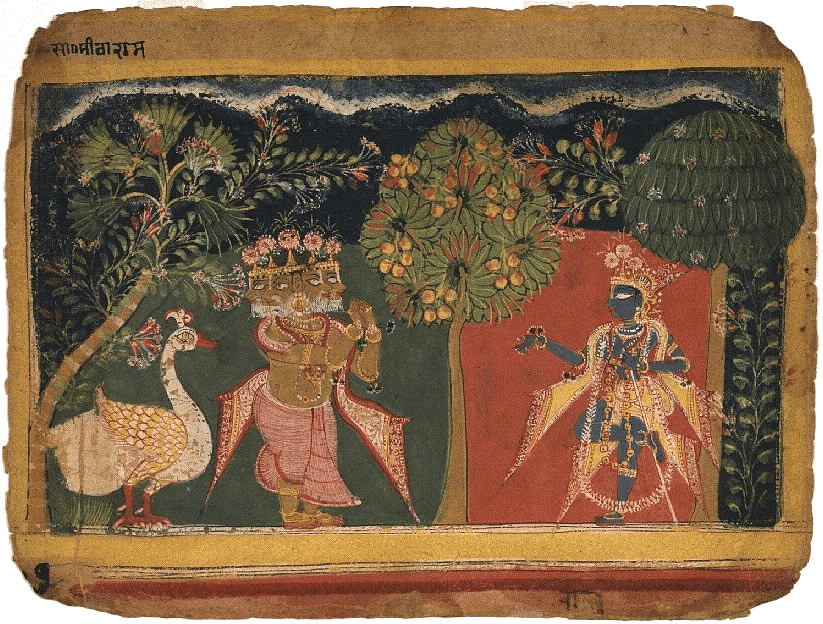
The picture is titled: 'Brahmâ Honors Krishna'. Page from a
dispersed series
of the Bhâgavata Purâna (Story of the Lord Vishnu), India,
probably
Delhi-Agra region, ca. 1525-40.
Courtesy Philadelphia
Museum
of
Art.
Production: Filognostic
Association
of The
Order of Time

Feed-back | Links | Downloads | Music | Pictures | What's New | Search | Donations



 Text
1
Text
1