

Canto 10
Canto 10
Chapter 38: Akrûra's Musing and Reception in Gokula
(1) S'rî S'uka said: 'The high-minded soul Akrûra spent the night in the city of Mathurâ [after 10.36: 40] and then mounted his chariot to go to Nanda's cowherd village. (2) On his way he experienced an exceptional amount of devotion for the greatly fortunate lotus-eyed Personality of Godhead, and thus he thought as follows: (3) 'What good works have I done, what severe penance did I suffer, or else of what worship have I been or what charity have I given, that I today may see Kes'ava? (4) My attainment of the presence of the One Praised in the Verses is, I think, for someone with a worldly mind [like me] as difficult to achieve as the chanting of the Vedas is for someone of the lowest class. (5) But enough of that, even for a fallen soul like me there is a chance to acquire the audience of Acyuta. Some time someone, pulled along by the river of time, may reach the other shore! (6) Today my impurity will be uprooted and my birth will bear fruit, for it are the lotus feet of the Supreme Lord, whereupon the yogis meditate, that I am going to respect. (7) Kamsa sending me here did me a great service indeed by obliging me to look for the feet of the Lord who descended into this world. It is by the effulgence of His rounded toenails that in the past many a soul succeeded in freeing himself from the hard to overcome darkness of a material existence. (8) On these [feet] that, marked by the red kunkum from the breasts of the gopîs, are worshiped by Brahmâ, S'iva and the other demigods, by S'rî the goddess of fortune, the sages and the devotees, He with His companions moves about in the forest while tending the cows. (9) The deer are passing me on my right side [an auspicious sign]! I certainly will behold Mukunda's beautiful cheeks and nose, His smiles, the glances of His reddish lotus eyes and the hair curling around His face. (10) Today I no doubt will enjoy the direct sight of Vishnu. I unfailingly will directly behold that paragon of beauty, who of His own accord assumed the form of a human being to diminish the burden of this earth. (11) Even though He is a witness [just like me] to the true and untrue, He is free from [false] ego. By that personal potency of Him He has dispelled the darkness and bewilderment of an existence in separation [see also 2.5: 14, 2.10: 8-9, 3.27: 18-30 and 10.3: 18]. Working from the inside out, He, by the created beings that manifested after He cast His glance upon the material energy of His creation, in their bodies can [only indirectly] be approached through the vital airs, senses and intelligence [see also 2.2: 35]. (12) His auspicious words, in combination with the qualities, activities and the incarnations [of Him and His expansions], put an end to all sins in the world and bring life, beauty and purity to the entire universe, while words devoid of these are considered as [useful as] things that beautify a corpse. (13) And now He, to the delight of the chief demigods, has descended in the dynasty of His faithful souls [the Sâtvatas] who maintain the codes of conduct, He who, with His presence in Vraja, spreads His fame as the Controller whose all-auspicious nature is glorified by the godly souls. (14) Today I will certainly see Him, the destination and spiritual master of all the great souls in the three worlds, He the real beauty and great feast for everyone endowed with eyes, He who exhibits the form that is the desire of the Goddess, He who is my safe haven, the One because of whom all my dawns became [a sign of] His auspicious presence. (15) The moment I alight from my chariot to respect the feet of the two Lords, the Principal Personalities upon whom even the yogis fix their intelligence in their self-realization, I will certainly bow down to Them as also to the friends [and the others] who live with Them in the forest. (16) And when I have fallen at the base of His feet, the Almighty One will place upon my head His lotus hand that dispels the fear for the serpent of time, the snake because of whose swift force the people terrified seek shelter. (17) By placing in that hand an offering, Purandara [see 8.13: 4] and also Bali [see 8.19] acquired rulership [the position of Indra] over the three worlds. It is the same hand that, fragrant like an aromatic flower, during the pastime with the ladies of Vraja, by its touch wiped away their fatigue [see 10.33]. (18) Even though I am a messenger sent by Kamsa, Acyuta will not adopt an attitude of enmity towards me. He, the Knower of the Field [of the body, see B.G. 13: 3], witnessing everything taking place inside and outside the heart, sees with a perfect vision. (19) Smiling affectionately He will look upon me, with my joined palms being fixed at the basis of His feet. With the immediate eradication of all my sins by His glance, I will thus be freed from doubt and achieve intense happiness. (20) With me [standing before Him] as His best friend and as a family member who is exclusively devoted to Him, He will close me in His two large arms. As a result my body will instantly become sanctified and my karma determined bonds will slacken. (21) When I, with my head down and palms joined, have achieved physical contact with Him, Urus'rava ['the renown Lord'] will address me with words like 'Oh Akrûra, dear relative...' Because of the Greatest of All Persons my life will thus be a success. How pitiable is the birth of the one not this way honored by Him! (22) No one is His favorite or best friend, nor is anyone disliked by Him, hated or held in contempt by Him [see B.G. 9: 29]. Nevertheless He reciprocates with His devotees [see also 10.32: 17-22] according to their actions, just like a [desire] tree from heaven that, upon approach, brings whatever one desires [see vaishnava pranâma]. (23) In addition His elder brother, the most excellent Yadu [Balarâma], smiling at me who stands there with a head bowed down, will embrace me, take hold of my hands and take me into His house to receive me with all respects, and then inquire how Kamsa fares together with the members of His family.'
(24) S'rî S'uka said: 'Thus on his way with his chariot pondering over Krishna, the son of S'vaphalka [see 9.24: 15] reached the village of Gokula as the sun was setting behind the mountain, oh King. (25) The imprints of His feet, of which the rulers of all worlds hold the pure dust on their crowns, he saw in the pasture: a wonderful decoration on the ground showing the shapes of the lotus, the barleycorn, the elephant goad and so on [see also 10.16: 18 and 10.30: 25*]. (26) The ecstasy of seeing them exited him greatly, made his hair stand on end and filled his eyes with tears. Getting down from his chariot he rolled himself in the footprints exclaiming: 'Oh this is the dust from my master's feet!' (27) This is what for all embodied beings is the goal of life: to give up one's pride, fear and sorrow when one is faced with the message of the signs of the Lord and hears about them and such [see 7.5: 23-24].
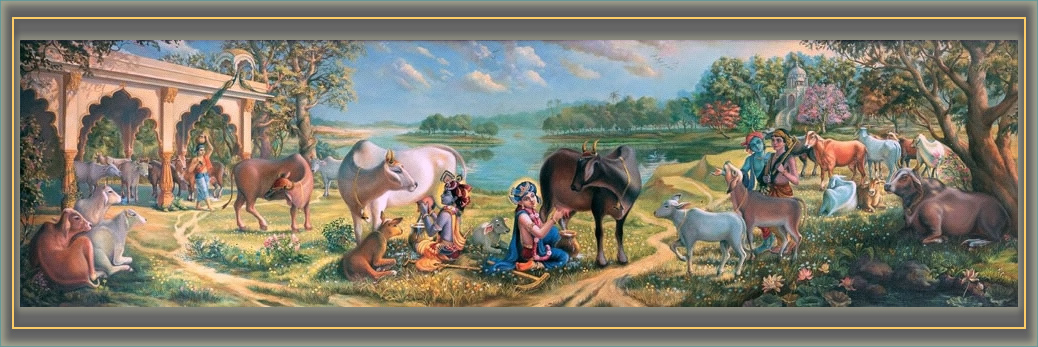
(28-33) In Vraja he saw Krishna and Râma, who, wearing yellow and blue garments and with eyes that looked like autumnal lotuses, were going to the place where the cows were milked. The two boys who are the shelter of the Goddess were, bluish-dark and fair skinned, most beautiful to behold with their mighty arms, attractive faces and a gait like that of a young elephant. With Their feet marked by the flag, bolt, goad and lotus, and with Their smiles and glances full of compassion, the two great souls increased the beauty of the cow pasture. They whose pastimes were so magnanimous and attractive, were freshly bathed, impeccably dressed, wore flower garlands and jeweled necklaces, and had smeared Their limbs with auspicious, fragrant substances. The two original, most excellent persons, who are the Cause and the Masters of the universe [see also 5.25], had for the welfare of that universe descended in Their distinct forms of Balarâma and Kes'ava. Oh King, with their effulgence They, as a mountain of emerald and a mountain of silver both decorated with gold, dispelled the darkness in all directions. (34) Quickly climbing down from his chariot Akrûra, overwhelmed with affection, prostrated himself at the feet of Râma and Krishna. (35) Seeing the Supreme Personality he, because of the tears of joy overflowing his eyes and the eruptions [of ecstasy] marking his limbs, in his eagerness could not announce himself, oh King. (36) The Supreme Lord, the Caretaker of the Surrendered Souls, recognized him, drew him near with His hand, which is marked with a chariot wheel [the cakra], and happily embraced him. (37-38) Thereupon the magnanimous Sankarshana [Râma] embraced him who stood there with his head bowed down. With His hand taking hold of his two hands He took him together with His younger brother into the house. There He inquired whether he had enjoyed a pleasant journey. He offered him an excellent seat and washed his feet with sweetened milk, as was prescribed as a form of reverential respect. (39) Donating a cow in charity and respectfully giving the tired guest a massage, the Almighty One faithfully served him pure food of different tastes [fit for a sacrifice]. (40) After having eaten Râma, the Supreme Knower of the Dharma, with love further arranged for herbs to serve the tongue and for fragrances and flower garlands for the highest satisfaction.
(41) After thus having honored him Nanda asked: 'Oh descendant of Das'ârha, how are you faring with the merciless Kamsa alive, that boss who is [treating his subjects] just like a butcher [deals] with sheep? (42) If he, being cruel and self-indulgent, killed the babies of his own sister to her great distress, what then would that mean for the well-being of his subjects, for you?'
(43) Thus by Nanda properly being respected with true and pleasing words, Akrûra shook off the fatigue of his journey.'


Third revised edition, loaded January 2, 2021.
Previous Aadhar edition and Vedabase links:
S'rî S'uka said: 'The high-minded soul Akrûra spent the night in the city of Mathurâ [after 10.36: 40] and then mounted his chariot to go to Nanda's cowherd village.S'rî S'uka said: 'Akrûra with his spirits high spending the night in the city of Mathurâ [after 10.36: 40], then mounted his chariot and set off for Nanda's cowherd village. (Vedabase)
On his way he experienced an exceptional amount of devotion for the greatly fortunate lotus-eyed Personality of Godhead, and thus he thought as follows:
On his way experienced he an exceptional amount of devotion for the greatly fortunate lotus-eyed Personality of Godhead and thought he thus like this: (Vedabase)
'What good works have I done, what severe penance did I suffer, or else of what worship have I been or what charity have I given, that I today may see Kes'ava?
'What good works have I done, what severe penance did I suffer or of what other worship was I that I today may see Kes'ava? (Vedabase)
My attainment of the presence of the One Praised in the Verses is, I think, for someone with a worldly mind [like me] as difficult to achieve as the chanting of the Vedas is for someone of the lowest class.
My reaching the presence of the One Praised in the Verses is, I think, for someone with a worldly mind as difficult to achieve as the chanting of the Vedas is for someone of the lowest class. (Vedabase)
But enough of that, even for a fallen soul like me there is a chance to acquire the audience of Acyuta. Some time, someone pulled along by the river of time, may reach the other shore!
But enough of that, even for a fallen soul like me there is a chance to have the audience of Acyuta; sometimes does someone pulled along by the river of time reach the other shore! (Vedabase)
Today my impurity will be uprooted and my birth will bear fruit, for it are the lotus feet of the Supreme Lord, whereupon the yogis meditate, that I am going to respect.
Today has the impure been uprooted and bears my birth indeed fruit, for it are the lotuslike feet of the Supreme Lord meditated upon by the yogis that I am going to respect. (Vedabase)
Kamsa sending me here did me a great service indeed by obliging me to look for the feet of the Lord who descended into this world. It is by the effulgence of His rounded toenails that in the past many a soul succeeded in freeing himself from the hard to overcome darkness of a material existence.
Kamsa sending me here indeed did me a great service by obliging me to look for the feet of the Lord who descended into this world; it is by the effulgence of His rounded toenails that in the past many succeeded in freeing themselves from the hard to overcome darkness of a material existence. (Vedabase)
On these [feet] that, marked by the red kunkum from the breasts of the gopîs, are worshiped by Brahmâ, S'iva and the other demigods, by S'rî the goddess of fortune, the sages and the devotees, He with His companions moves about in the forest while tending the cows.
It is they [those feet], worshiped by Lord Brahmâ, S'iva, the other demigods, by S'rî the goddess of fortune, the sages and the devotees, with which He for tending the cows with His companions moved about in the forest that was marked by the kunkum from the breasts of the gopîs. (Vedabase)
The deer are passing me on my right side [an auspicious sign]! I certainly will behold Mukunda's beautiful cheeks and nose, His smiles, the glances of His reddish lotus eyes and the hair curling around His face.
For certain will I behold the beautiful cheeks and nose, the smiles and glances of His reddish lotuslike eyes and the hair curling around the face of Mukunda; indeed are the deer passing me to the right [an auspicious omen]! (Vedabase)
Today I no doubt will enjoy the direct sight of Vishnu. I unfailingly will directly behold that paragon of beauty, who of His own accord assumed the form of a human being to diminish the burden of this earth.
No doubt will I today enjoy the direct sight of Vishnu, will I perceive the Abode of Beauty, who by His own desire to diminish the burden of this earth has assumed the form of a human being. (Vedabase)
Even though He is a witness [just like me] to the true and untrue, He is free from [false] ego. By that personal potency of Him He has dispelled the darkness and bewilderment of an existence in separation [see also 2.5: 14, 2.10: 8-9, 3.27: 18-30 and 10.3: 18]. Working from the inside out, He, by the created beings that manifested after He cast His glance upon the material energy of His creation, in their bodies can [only indirectly] be approached through the vital airs, senses and intelligence [see also 2.2: 35].
He, though being a witness [like me] to the true and untrue, is void of I-ness and has by that personal potency of His dispelled the darkness and bewilderment of an existence in separation [see also 2.5: 14, 2.10: 8-9, 3.27: 18-30 and 10.3: 18]; it is He, who works from the inside out, who by the created beings who manifest themselves when He casts His glance upon the material energy of His creation only indirectly can be seen through the vital airs, senses and intelligence in their bodies [see also 2.2: 35]. (Vedabase)
His auspicious words, in combination with the qualities, activities and the incarnations [of Him and His expansions], put an end to all sins in the world and bring life, beauty and purity to the entire universe, while words devoid of these are considered as [useful as] things that beautify a corpse.
The auspicious words, joined with the qualities, activities and the incarnations [of Him and His expansions], destroy all sins in the world and give life, beauty and purity to the entire universe, while words void of these are considered as things beautiful on a corpse. (Vedabase)
And now He, to the delight of the chief demigods, has descended in the dynasty of His faithful souls [the Sâtvatas] who maintain the codes of conduct, He who, with His presence in Vraja, spreads His fame as the Controller whose all-auspicious nature is glorified by the godly souls.
And now has descended indeed in His own dynasty of loyals [Sâtvatas] He who maintains the codes, He who as the chief of the immortals creating delight spreads His fame being present in Vraja as the Controller of whose all-auspicious nature the godly sing. (Vedabase)
Today I will certainly see Him, the destination and spiritual master of all the great souls in the three worlds, He the real beauty and great feast for everyone endowed with eyes, He who exhibits the form that is the desire of the Goddess, He who is my safe haven, the One because of whom all my dawns became [a sign of] His auspicious presence.
For certain will I today see Him, the destination and spiritual master of the great souls of all three worlds, the real beauty and great feast to all who have eyes, He who exhibits the form that is the desire of the goddess, who is my safe haven of whom all dawns became His auspicious presence. (Vedabase)
The moment I alight from my chariot to respect the feet of the two Lords, the Principal Personalities upon whom even the yogis fix their intelligence in their self-realization, I will certainly bow down to Them as also to the friends [and the others] who live with Them in the forest.
The moment I alight from my chariot to respect the feet of the two Lords, the Principal Personalities to whom even the yogis meditating hold on for their self-realization, will I bow down before Them as also to the friends living with Them in the forest. (Vedabase)
And when I have fallen at the base of His feet, the Almighty One will place upon my head His lotus hand that dispels the fear for the serpent of time, the snake because of whose swift force the people terrified seek shelter.
And having fallen at the base of the feet will the Almighty place upon my head His very own lotuslike hand that makes one unafraid of the serpent of time of whose swift force the people greatly disturbed search for shelter. (Vedabase)
By placing in that hand an offering, Purandara [see 8.13: 4] and also Bali [see 8.19] acquired rulership [the position of Indra] over the three worlds. It is the same hand that, fragrant like an aromatic flower, during the pastime with the ladies of Vraja by its touch, wiped away their fatigue [see 10.33].
Putting into that hand a respectful offering attained Purandara [see 8.13: 4] and Bali [see 8.19] as well rulership [the position of Indra] over the three worlds; it is that hand which, during the pastime in contact with the ladies of Vraja, fragrant like an aromatic flower wiped away the fatigue [see 10.33]. (Vedabase)
Even though I am a messenger sent by Kamsa, Acyuta will not adopt an attitude of enmity towards me. He, the Knower of the Field [of the body, see B.G. 13: 3], witnessing everything taking place inside and outside the heart, sees with a perfect vision.
Toward me, though being a messenger of Kamsa, will Acyuta develop no attitude of enmity; He is the overseer of everything who inside and outside the heart is the Knower of the field [of the body, see B.G. 13: 3], the Knower who with a perfect vision sees whatever that is sought and tried. (Vedabase)
Smiling affectionately He will look upon me, with my joined palms being fixed at the basis of His feet. With the immediate eradication of all my sins by His glance, I will thus be freed from doubt and achieve intense happiness.
Fixed at the base of His feet with joined palms will He look upon me smiling affectionately so that with the immediate eradication of all contamination by His glance I will be freed from doubt and achieve intense happiness. (Vedabase)
With me [standing before Him] as His best friend and as a family member who is exclusively devoted to Him, He will close me in His two large arms. As a result my body will instantly become sanctified and my karma determined bonds will slacken.
As the best of friends and a family member having Him exclusively as my object of worship, will He embrace me with His two large arms whereupon as a result of which my body instantly will become sanctified and my karma-given bondage will slacken. (Vedabase)
When I, with my head down and palms joined, have achieved physical contact with Him, Urus'rava ['the renown Lord'] will address me with words like 'Oh Akrûra, dear relative...' Because of the Greatest of All Persons my life will thus be a success. How pitiable is the birth of the one not this way honored by Him!
When I, head down and palms joined, have achieved the physical contact, will Urus'rava ['the Lord of Great Renown'] address me with words like 'O Akrûra, dearest relative' and will thus because of the Greatest of All Persons my birth be a success; indeed is he whose birth is not honored like that to be pitied! (Vedabase)
No one is His favorite or best friend, nor is anyone disliked by Him, hated or held in contempt by Him [see B.G. 9: 29]. Nevertheless He reciprocates with His devotees [see also 10.32: 17-22] according to their actions, just like a [desire] tree from heaven that, upon approach, brings whatever one desires [see vaishnava pranâma].
No one is His favorite or best friend, nor is anyone indeed disliked, hated or contemptible to Him either [see B.G. 9: 29] and still does He reciprocate with His devotees [see also 10.32: 17-22] for they are just like [desire-] trees from heaven that resorted to give whatever is wished for [see vaishnava pranâma]. (Vedabase)
In addition His elder brother, the most excellent Yadu [Balarâma], smiling at me who stands there with a head bowed down, will embrace me, take hold of my hands and take me into His house to receive me with all respects, and then inquire how Kamsa fares together with the members of His family.'
Furthermore will His elder brother, the most excellent Yadu, smiling at me standing there with a bowed head embrace me, take hold of my hands and take me into His house to receive me with all respects and inquire how Kamsa fares with the members of His family.' (Vedabase)
S'rî S'uka said: 'Thus on his way with his chariot pondering over Krishna, the son of S'vaphalka [see 9.24: 15] reached the village of Gokula as the sun was setting behind the mountain, oh King.
S'rî S'uka said: 'Thus on his way with his chariot pondering over Krishna reached the son of S'vaphalka [see 9.24: 15] the village of Gokula as the sun was setting behind the mountain, o King. (Vedabase)
The imprints of His feet, of which the rulers of all worlds hold the pure dust on their crowns, he saw in the pasture: a wonderful decoration on the ground showing the shapes of the lotus, the barleycorn, the elephant goad and so on [see also 10.16: 18 and 10.30: 25*].
The prints of His feet, of which the rulers of all worlds hold the pure dust on their crowns, saw he in the earth of the pasture: a wonderful decoration distinguished by the lotus, the barleycorn, the elephant goad and so on [see also 10.16: 18 and 10.30: 25*]. (Vedabase)
The ecstasy of seeing them exited him greatly, made his hair stand on end and filled his eyes with tears. Getting down from his chariot he rolled himself in the footprints exclaiming: 'Oh this is the dust from my masters feet!'
The ecstasy of seeing them exited him greatly, made his hair stand on end and filled his eyes with tears; getting down from his chariot he rolled himself in the prints exclaiming: 'Oh this is the dust from my masters feet!' (Vedabase)
This is what for all embodied beings is the goal of life: to give up one's pride, fear and sorrow when one is faced with the message of the signs of the Lord and hears about them and such [see 7.5: 23-24].
This is what of all embodied beings is the goal of life: to give up the pride, fear and sorrow from being commanded [by mâyâ] when one has within one's sight the signs of the Lord that one hears about and so on [see 7.5: 23-24]. (Vedabase)
In Vraja he saw Krishna and Râma, who, wearing yellow and blue garments and with eyes that looked like autumnal lotuses, were going to the place where the cows were milked. The two boys who are the shelter of the Goddess were, bluish-dark and fair skinned, most beautiful to behold with their mighty arms, attractive faces and a gait like that of a young elephant. With Their feet marked by the flag, bolt, goad and lotus, and with Their smiles and glances full of compassion, the two great souls increased the beauty of the cow pasture. They whose pastimes were so magnanimous and attractive, were freshly bathed, impeccably dressed, wore flower garlands and jeweled necklaces, and had smeared Their limbs with auspicious, fragrant substances. The two original, most excellent persons, who are the Cause and the Masters of the universe [see also 5.25], had for the welfare of that universe descended in Their distinct forms of Balarâma and Kes'ava. Oh King, with their effulgence They, as a mountain of emerald and a mountain of silver both decorated with gold, dispelled the darkness in all directions.
In Vraja he saw Krishna and Râma, who with their eyes that looked like autumnal lotuses were going to where the cows were milked, wearing yellow and blue clothes. The two shelters to the goddess were bluish-dark and fair skinned youngsters most beautiful to behold with mighty arms, attractive faces and a gait like that of an elephant. With Their feet marked by the flag, bolt, goad and lotus did the great souls with Their smiles and glances full of compassion beautify the cow pasture. They whose pastimes were so magnanimous and attractive were freshly bathed and wore jeweled necklaces, flower garlands, had Their limbs anointed with auspicious, fragrant substances and were spotless in their apparel. The two original, most excellent persons, who are the Cause and Lord of the universe [see also 5.25] had for the welfare of that universe descended in Their distinct forms of Balarâma and Kes'ava. O King with their effulgence dispelled They, as a mountain of emerald and a mountain of silver both decorated with gold, in all directions the darkness. (Vedabase)
Quickly climbing down from his chariot Akrûra, overwhelmed with affection, prostrated himself at the feet of Râma and Krishna.
Quickly climbing down from his chariot prostrated Akrûra, overwhelmed by affection, himself at the feet of Râma and Krishna. (Vedabase)
Seeing the Supreme Personality he, because of the tears of joy overflowing his eyes and the eruptions [of ecstasy] marking his limbs, in his eagerness could not announce himself, oh King.
Seeing the Supreme Personality was he, because of the tears of joy overflowing his eyes and the eruptions [of ecstasy] marking his limbs, in his eagerness not able to announce himself, o King. (Vedabase)
The Supreme Lord, the Caretaker of the Surrendered Souls, recognized him, drew him near with His hand, which is marked with a chariot wheel [the cakra], and happily embraced him.
The Supreme Lord, the Caretaker of the Surrendered, recognizing him, drew him with His hand marked with a chariot wheel [the cakra] near and pleased embraced him. (Vedabase)
Thereupon the magnanimous Sankarshana [Râma] embraced him who stood there with his head bowed down. With His hand taking hold of his two hands He took him together with His younger brother into the house. There He inquired whether he had enjoyed a pleasant journey. He offered him an excellent seat and washed his feet with sweetened milk, as was prescribed as a form of reverential respect.
Next embraced the magnanimous Sankarshana [Râma] him who stood there with his head down, and with His hand taking hold of his two hands took He him with His younger brother into the house. Following He inquired whether he had a pleasant journey and offered He him an excellent seat, and washed He, as was prescribed as a form of reverential respect, his feet with sweetened milk. (Vedabase)
Donating a cow in charity and respectfully giving the tired guest a massage, the Almighty One faithfully served him pure food of different tastes [fit for a sacrifice].
Donating a cow in charity and respectfully giving the tired guest a massage served the Almighty One faithfully him the right food of different tastes. (Vedabase)
After having eaten Râma, the Supreme Knower of the Dharma, with love further arranged for herbs to serve the tongue and for fragrances and flower garlands for the highest satisfaction.
After the meal arranged Râma the Supreme Knower of the Dharma with love further for herbs to serve the tongue and for fragrances and flower garlands to give the highest satisfaction. (Vedabase)
After thus having honored him Nanda asked: 'Oh descendant of Das'ârha, how are you faring with the merciless Kamsa alive, that boss who is [treating his subjects] just like a butcher [deals] with sheep?
Nanda asked the honored one: 'O descendant of Das'ârha, how are you, with the merciless Kamsa alive, that boss that is just like a butcher is with sheep? (Vedabase)
If he, being cruel and self-indulgent, killed the babies of his own sister to her great distress, what then would that mean for the well-being of his subjects, for you?'
If he cruel and self-indulgent killed his own sister's babies to her great distress, what then, I dare say, would that mean to his subjects, to someone like you?' (Vedabase)
Thus by Nanda properly being respected with true and pleasing words, Akrûra shook off the fatigue of his journey.'
Thus by Nanda properly honored with true and pleasing words put Akrûra aside the fatigue of the road.' (Vedabase)


The text and audio are offered under the conditions of
the
Creative
Commons Attribution-Noncommercial-Share Alike 3.0 Unported
License.
The painting
of Krishna and Balarâma in Vraja is © of Vrindavan Das, and was used with
permission.
Production: Filognostic
Association of The Order of Time.

Feed-back | Links | Downloads | Music | Pictures | What's New | Search | Donations



 Text 1